
Why Affiliate Funnels Matter
Sending visitors directly to an affiliate offer can work in some situations, but it leaves too much to chance. Most people are not ready to buy the first time they discover your content. They may need more information, more trust, or simply more time before making a decision.
There is another important reason to build your own funnel: many advertising platforms restrict or discourage direct linking to affiliate offers. Depending on the platform, offer, landing page, and advertising policy, sending paid traffic straight from an ad to a third-party affiliate sales page may cause an ad to be rejected or make the campaign difficult to approve.
Instead, affiliate marketers commonly send traffic to a page they control first. This might be a helpful article, comparison page, review, landing page, quiz, lead magnet, or email opt-in page. That gives you an opportunity to provide real value, establish trust, collect leads when appropriate, and introduce the affiliate recommendation in context.
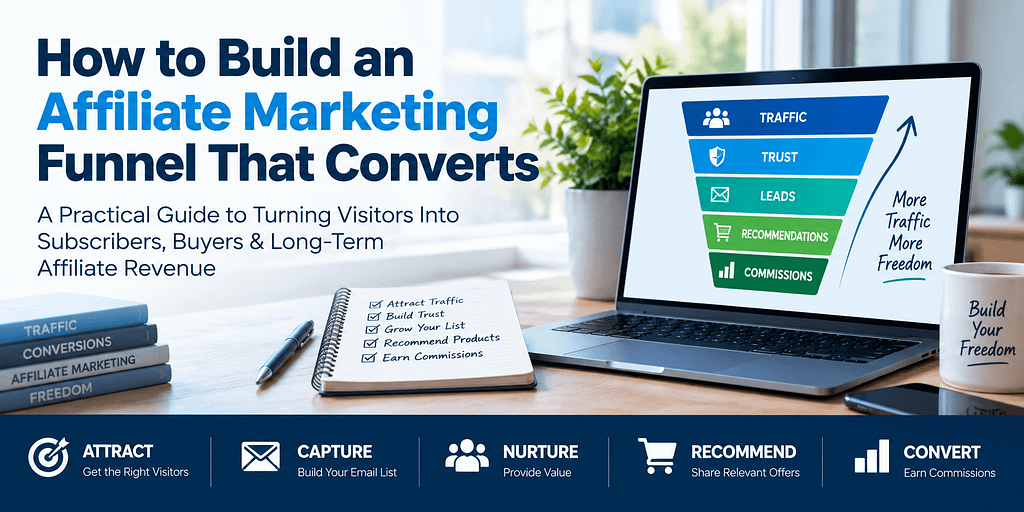
An affiliate marketing funnel creates a clear path from discovery to action. Rather than depending on one ad or one affiliate link to make the sale, you create a system that can attract visitors → capture leads → nurture prospects → recommend relevant products → generate commissions.
How an Affiliate Marketing Funnel Works
An affiliate marketing funnel is simply the path a visitor follows from first discovering your content to eventually taking an action that generates revenue. Instead of expecting a visitor to see one affiliate link and immediately buy, the funnel moves them through a series of logical steps that build interest, trust, and buying confidence.
A typical affiliate funnel looks like this: Traffic → Helpful Content → Lead Capture → Follow-Up → Product Recommendation → Affiliate Click → Conversion. Not every visitor will complete every step, and not every funnel needs every stage. The goal is to create a natural path that makes it easier for the right visitor to move from information seeker to customer.
1. Attract the Right Traffic
Your funnel begins by attracting people who are actually interested in the problem, topic, or product you’re promoting. Traffic can come from SEO, YouTube, social media, Pinterest, email, or paid advertising. The goal isn’t simply to generate the most visitors—it’s to attract visitors whose needs match the content and offers in your funnel.
Key principle: Qualified traffic is more valuable than large amounts of untargeted traffic.
2. Capture the Lead
Most visitors will not purchase the first time they discover your website. If they leave without giving you a way to reach them again, you may lose that visitor permanently.
That is why many successful affiliate funnels use an email opt-in, lead magnet, newsletter, free guide, checklist, comparison chart, or other useful resource to turn anonymous visitors into subscribers.
Once someone joins your email list, you are no longer dependent on Google, social media, or paid advertising to bring that person back every time. You can continue the conversation directly through email.
The goal at this stage is simple:
Visitor → Valuable Free Resource → Email Subscriber
The important part is the value exchange. Give people a genuine reason to subscribe rather than simply displaying a generic “Join Our Newsletter” form.
3. Nurture the Relationship
Getting someone onto your email list is only the beginning. The next step is building enough trust that subscribers begin to see you as a useful source of information rather than someone who simply sends promotional offers.
This is where email follow-up becomes powerful. Instead of immediately pushing products, use your emails to answer questions, solve problems, share useful resources, and guide subscribers toward the next logical step.
A simple nurture sequence might include educational emails, tutorials, case studies, product comparisons, personal insights, and recommendations that relate directly to why the subscriber joined your list.
Over time, those interactions can turn a cold visitor into someone who knows your content, trusts your recommendations, and is much more likely to consider an affiliate product you recommend.
The goal at this stage is:
Subscriber → Helpful Content → Trust → Buying Confidence
The strongest affiliate funnels don’t treat every email as a sales pitch. They provide value first and introduce relevant offers when those offers genuinely help the subscriber solve a problem.
4. Recommend the Right Affiliate Product
Once you have attracted the right visitor, captured the lead, and built trust, you can introduce an affiliate product that fits the person’s needs.
This is where many affiliate marketers make a mistake. They choose products based primarily on commission rates instead of asking whether the product is genuinely a good match for their audience.
A strong funnel does the opposite. The recommendation should feel like the natural next step after the information you’ve already provided.
For example, someone reading a beginner’s guide to building an affiliate website may be ready for a hosting recommendation. Someone researching AI writing tools may be better served by a detailed comparison of the tools that fit their workflow.
Your content can introduce affiliate offers through:
- Product reviews and comparisons
- Tutorials and demonstrations
- Resource pages
- Email recommendations
- Buying guides
- Case studies
- Contextual calls to action
The key is relevance. Match the offer to the visitor’s problem, intent, and stage in the buying journey.
The goal at this stage is:
Trust → Relevant Recommendation → Affiliate Click → Merchant
And remember: your job isn’t to sell every visitor. Your job is to help the right visitor make the right decision.
5. Convert & Optimize
A funnel does not end when someone clicks your affiliate link. The final stage is understanding what happens throughout the funnel and improving the areas where potential customers are dropping off.
Track the numbers that tell you how well each stage is performing. Depending on your funnel, those may include traffic, opt-in rate, email open and click rates, affiliate-link clicks, conversions, and revenue.
For example, if a page receives plenty of qualified traffic but very few people join your email list, the problem may be the lead magnet or opt-in offer. If subscribers open your emails but rarely click your recommendations, the messaging or offer may need improvement.
Avoid changing everything at once. Identify the weakest point, make one meaningful improvement, measure the result, and then decide what to change next.
The optimization cycle is:
Measure → Find the Weak Point → Improve → Test → Learn → Repeat
Over time, even relatively small improvements at several stages of the funnel can significantly increase the value of the traffic you already have.
Key principle: A profitable affiliate funnel is not something you build once and forget. It is a system you continuously improve based on real visitor behavior.
What You’ll Learn
By the end of this guide, you’ll understand how to design a complete affiliate marketing funnel that attracts qualified visitors, captures leads, builds trust, introduces relevant affiliate offers, and improves conversions over time.
- How affiliate marketing funnels work and why they improve your chances of converting traffic
- How to choose the right funnel structure for your audience and traffic source
- How to create content that attracts visitors with the right intent
- How to build landing pages that move visitors toward a specific action
- How to turn visitors into email subscribers with valuable lead magnets
- How to nurture subscribers and introduce affiliate products naturally
- How to measure each stage of your funnel and identify conversion problems
- How to create a practical 90-day plan for building and improving your funnel
The goal isn’t to build the most complicated funnel. It’s to build the simplest funnel that consistently moves the right people toward the right offer.
In This Guide
- Why Affiliate Funnels Matter
- How an Affiliate Marketing Funnel Works
- What You’ll Learn
- In This Guide
- Chapter 1: Understand the Affiliate Marketing Funnel
- Chapter 2: Choose the Right Funnel for Your Audience
- Chapter 3: Create Content That Attracts the Right Visitors
- Chapter 4: Build High-Converting Landing Pages
- Chapter 5: Turn Visitors Into Email Subscribers
- Chapter 6: Use Email to Nurture & Recommend Affiliate Products
- Chapter 7: Track & Optimize Your Affiliate Funnel
- Chapter 8: Build Your 90-Day Affiliate Funnel Plan
- Final Thoughts
Chapter 1: Understand the Affiliate Marketing Funnel
An affiliate marketing funnel is the journey a potential customer takes from first discovering you to eventually clicking an affiliate recommendation and completing an action with the merchant.
The important word is journey. Visitors rarely arrive at your website with the same level of knowledge, trust, or buying intent. One person may be researching a problem for the first time, while another may already be comparing products and preparing to buy.
A good funnel recognizes those differences and gives each visitor a logical next step.
The Four Levels of Funnel Intent
1. Awareness
The visitor has a problem, goal, or interest but may not yet know which solution they need. Educational articles, beginner guides, videos, social posts, and search-focused content work well here.
2. Consideration
The visitor understands the problem and is researching possible solutions. Comparisons, tutorials, case studies, product categories, and “best” guides can help them narrow their choices.
3. Decision
The visitor is close to taking action. Detailed reviews, product comparisons, demonstrations, bonuses, FAQs, and strong calls to action can help them make a confident decision.
4. Conversion & Follow-Up
The visitor clicks through to the merchant and may purchase, sign up, request information, or complete another commission-generating action. Your funnel should then continue nurturing subscribers rather than treating the first conversion as the end of the relationship.
Funnel principle: Match your content and recommendation to where the visitor is in the decision process. Trying to sell too early can lose trust; waiting too long can lose the conversion.
Owned Traffic vs. Rented Traffic
One of the biggest advantages of an affiliate funnel is that it can help you turn traffic you temporarily receive from another platform into an audience you can reach again.
Search engines, social networks, video platforms, and advertising networks are valuable traffic sources—but you do not control them. Algorithms change, advertising costs increase, accounts can be restricted, and platform policies can change with little notice.
This is sometimes described as rented traffic. You can benefit from the platform’s audience, but the platform controls your access to it.
Your website and email list are different. They are assets you control much more directly. When a visitor reaches your website and voluntarily joins your email list, you have created a direct relationship that does not require paying for another click every time you want to communicate with that person.
Rented Traffic → Your Website → Lead Capture → Email List → Ongoing Relationship
This becomes especially important when using paid advertising. Many advertising platforms have rules governing landing pages, affiliate promotions, redirects, destination quality, and other aspects of affiliate campaigns. Instead of building a business that depends on sending an ad directly to somebody else’s sales page, a funnel gives you a destination you control where you can provide value first and introduce relevant affiliate recommendations in context.
Build an Asset, Not Just a Click
Imagine paying for 1,000 visitors and sending every one of them directly to an affiliate offer. The people who don’t convert disappear, and reaching them again generally requires generating another visit.
Now imagine sending those same qualified visitors through useful content or a landing page and giving interested visitors a compelling reason to subscribe. Even if they don’t purchase immediately, some become part of an audience you can continue helping.
That changes the economics of affiliate marketing.
Instead of thinking only:
Traffic → Affiliate Click → Commission
you begin building:
Traffic → Audience → Trust → Multiple Opportunities to Help → Relevant Offers → Long-Term Revenue
Chapter 1 Takeaway: A funnel is more than a way to increase conversion rates. It helps turn temporary traffic into relationships and relationships into business assets you can continue developing over time.
Chapter 2: Choose the Right Funnel for Your Audience
There is no single affiliate funnel that works for every niche, traffic source, or audience. A funnel that works well for someone coming from Google Search may look very different from one designed for Facebook ads, YouTube viewers, Pinterest traffic, or an existing email audience.
The best funnel is usually not the most complicated one. It is the funnel that matches where the visitor came from, what they are looking for, and how much trust they need before making a decision.
Four Practical Affiliate Funnel Models
1. Content-to-Affiliate Funnel
This is one of the simplest funnels and works particularly well with SEO, YouTube, Pinterest, and other organic traffic sources.
Traffic → Helpful Content → Affiliate Recommendation → Merchant
A visitor discovers a tutorial, review, comparison, buying guide, or other useful content. The content answers their questions and naturally introduces an appropriate affiliate product.
This model is simple, but once the visitor leaves, you may have no way to reach them again.
Best for: Visitors with relatively strong buying intent and content closely connected to a product or service.
2. Content-to-Email Funnel
This adds lead capture before or alongside your affiliate recommendations.
Traffic → Helpful Content → Lead Magnet → Email Subscriber → Follow-Up → Affiliate Recommendation
Instead of relying entirely on an immediate purchase, you give interested visitors a reason to join your email list. You can then continue helping them and introduce relevant products over time.
Best for: Educational niches, higher-consideration purchases, recurring offers, and audiences that need more trust before buying.
3. Paid-Traffic Landing Page Funnel
Paid traffic often requires a more deliberate path.
Ad → Landing Page → Lead Capture or Helpful Content → Follow-Up → Affiliate Offer
Your landing page should provide genuine value and accurately represent where the visitor is going next. It also gives you control over the message rather than relying entirely on a merchant’s sales page.
Advertising and affiliate policies vary by platform and offer, so always review the current rules of the advertising platform and affiliate program before launching a campaign.
Best for: Marketers using paid search, social advertising, native advertising, or other paid acquisition channels.
4. Comparison & Review Funnel
This funnel targets visitors who are already closer to making a decision.
Search or Content → Comparison/Review → Recommendation → Affiliate Click → Merchant
Examples include Product A vs. Product B, “best tools for…” pages, detailed reviews, pricing comparisons, and alternatives pages.
Because the visitor already has commercial intent, the funnel can be shorter—but the recommendation must still be credible, useful, and transparent.
Best for: Bottom-of-funnel visitors actively evaluating products.
Key principle: Start with the shortest funnel that gives your visitor enough information and trust to make a confident decision. Add additional steps only when they serve a clear purpose.
How to Choose Your Funnel
Before building anything, answer four questions:
1. Where is the traffic coming from?
Organic search visitors, YouTube viewers, social-media users, email subscribers, and paid-ad visitors arrive with different expectations. Your funnel should make the transition from the traffic source to your page feel natural.
2. What is the visitor’s intent?
Someone searching “what is affiliate marketing?” is at a very different stage from someone searching “best email marketing software for affiliate marketers.” The stronger the buying intent, the shorter your funnel may need to be.
3. How much trust does the purchase require?
A low-cost, familiar product may require very little education. An expensive subscription, financial commitment, unfamiliar product, or complex service may require considerably more explanation and follow-up before someone is comfortable taking action.
4. Do you need to capture the lead?
If visitors are unlikely to purchase immediately—or if you are paying to acquire the traffic—lead capture can make the funnel much more valuable because you have an opportunity to continue the relationship after the first visit.
A Simple Funnel Decision Framework
High buying intent + simple product
→ Content → Affiliate Offer
Research intent + multiple choices
→ Comparison/Review → Recommendation → Affiliate Offer
Educational traffic + longer decision process
→ Content → Lead Magnet → Email → Affiliate Offer
Paid traffic + audience needs education
→ Ad → Landing Page → Lead Capture → Follow-Up → Affiliate Offer
Chapter 2 Takeaway: Don’t copy another marketer’s funnel simply because it looks sophisticated. Start with your traffic source, visitor intent, and offer. Then build the shortest path that gives the visitor enough value and confidence to take the next step.
Chapter 3: Create Content That Attracts the Right Visitors
A funnel can only perform as well as the traffic entering it. If your content attracts people who have little interest in the problem your affiliate offer solves, even an excellent landing page or email sequence will struggle to convert.
That is why funnel optimization begins before the visitor ever reaches the funnel. Your content should attract people whose questions, problems, and goals naturally connect to the products and services you recommend.
Match Content to Search & Buyer Intent
Someone searching for a broad educational topic usually needs a different next step than someone actively comparing products.
Think of affiliate content in three broad stages:
Informational Intent
The visitor is learning about a problem or topic.
Examples:
- What is email marketing?
- How does affiliate marketing work?
- How to start a blog
Best funnel goal: Educate → Build Trust → Capture Lead
Commercial Investigation
The visitor understands the problem and is evaluating possible solutions.
Examples:
- Best email marketing platforms for affiliate marketers
- ChatGPT vs. Claude
- Best web hosting for affiliate websites
Best funnel goal: Compare → Recommend → Affiliate Click
Transactional Intent
The visitor is close to making a decision and may be looking for pricing, features, discounts, trials, or a specific product.
Examples:
- Product pricing
- Product free trial
- Product review
- Product coupon or discount
Best funnel goal: Answer Final Questions → Clear CTA → Merchant
Build Content Around the Funnel
Instead of publishing articles independently and hoping visitors eventually find an affiliate link, decide what role each piece of content plays in the customer journey.
A beginner guide might lead to a checklist or email course. That email sequence could lead to a product comparison. The comparison could then lead to the merchant.
Educational Content → Lead Magnet → Email Follow-Up → Comparison → Affiliate Recommendation
This turns separate pieces of content into a connected marketing system.
Create Content Clusters
A strong affiliate funnel does not need to depend on a single article. Build several related pieces of content around the same audience problem.
For example, an affiliate marketer promoting email marketing software might create:
- How to Build an Email List for Affiliate Marketing
- Best Email Marketing Platforms for Affiliate Marketers
- Email Platform A vs. Email Platform B
- How to Create an Affiliate Email Sequence
- Detailed review of the recommended platform
These pages can internally link to one another and move visitors naturally from education toward evaluation and action.
Chapter 3 principle: Don’t ask only, “Can this article rank?” Ask, “Who will this article attract, what will they need next, and where should the funnel take them?”
Give Every Important Page a Next Step
Every important piece of affiliate content should answer two questions:
1. What does this visitor need right now?
2. What is the most useful next step after this content?
That next step might be another educational article, a comparison guide, an email opt-in, a product review, a tutorial, or an affiliate recommendation.
The mistake is placing the same generic call to action on every page. A visitor reading a beginner tutorial should not necessarily receive the same CTA as someone reading a detailed product comparison.
Match the CTA to the Content
Use this framework:
Educational content
→ “Learn More” → Related Guide or Lead Magnet
Problem-solving content
→ “See How” → Tutorial or Recommended Solution
Comparison content
→ “Compare Options” → Detailed Comparison or Review
Product-focused content
→ “Check Features / Pricing” → Affiliate Merchant
Email content
→ “Continue Reading” → Website Content or Relevant Offer
The closer the visitor gets to making a buying decision, the more specific your call to action can become.
Use Internal Links to Move Visitors Through the Funnel
Internal links aren’t only for SEO. They can also guide visitors from one stage of the funnel to the next.
For example:
Beginner Guide → Strategy Guide → Product Comparison → Detailed Review → Affiliate Offer
This allows someone who isn’t ready to buy today to continue learning without leaving your website.
If you want to go deeper into creating content that ranks and moves readers toward action, read our guide to creating affiliate content that ranks, helps, and converts.
Chapter 3 Takeaway: Traffic becomes more valuable when every piece of content has a purpose. Attract the right visitor, satisfy the current intent, and provide a logical next step that moves the relationship forward.
Chapter 4: Build High-Converting Landing Pages
A landing page is where your funnel asks the visitor to take a specific next step. That might be joining your email list, downloading a free resource, reading a comparison, watching a demonstration, or continuing to an affiliate offer.
Unlike a general website page with multiple competing options, an effective landing page is built around one primary goal.
One Page, One Primary Action
When visitors arrive from search, social media, YouTube, or paid advertising, they should quickly understand three things:
1. Where am I?
The headline should immediately connect with the reason the visitor clicked.
2. What’s in it for me?
Explain the benefit—not simply the features of your page, lead magnet, or recommended product.
3. What should I do next?
Give the visitor a clear call to action.
A simple landing-page structure might look like:
Headline → Problem → Benefit → Helpful Information → Proof/Trust → CTA
The more choices you place in front of the visitor, the easier it becomes for them to do nothing.
Maintain Message Match
The message that brings someone to the landing page should match what they find when they arrive.
For example, if an ad promises:
“Free Affiliate Marketing Niche Checklist”
the landing page should immediately reinforce that exact offer—not open with a generic explanation of affiliate marketing.
The same principle applies to organic traffic. A visitor clicking a search result about choosing an affiliate niche should land on content that immediately addresses choosing a niche.
Traffic Message → Landing Page Message → CTA
When those three elements align, the visitor experiences a logical continuation instead of feeling like they’ve been sent somewhere unexpected.
Build Trust Before the CTA
Before asking someone to subscribe, click, or purchase, give them enough information to feel comfortable taking the next step.
Depending on the page, trust can come from:
- Clear explanations
- Genuine product experience
- Screenshots or demonstrations
- Pros and cons
- Testimonials or legitimate social proof
- Transparent pricing information
- Privacy reassurance near email forms
- Clear affiliate disclosures
- Easy-to-understand calls to action
Avoid manufactured urgency, exaggerated income claims, fake scarcity, or promises you cannot substantiate. Short-term pressure can undermine the trust the rest of your funnel is designed to build.
Landing-page principle: Remove unnecessary distractions, make the value obvious, and give the visitor one clear next step.
Landing Pages for Paid Affiliate Traffic
Advertising policies can vary by platform and can change over time, so always review the current advertising requirements before launching a paid affiliate campaign.
Paid traffic makes your landing page especially important because you are paying for every visitor who enters the funnel.
Sending an ad directly to an affiliate offer may not be permitted or may be restricted depending on the advertising platform, affiliate program, offer, and destination. Even when direct linking is permitted, sending visitors immediately to a merchant means you lose control over much of the customer journey.
A landing page you control gives you an opportunity to bridge the gap between the advertisement and the affiliate offer.
A practical paid affiliate funnel might look like:
Ad → Your Landing Page → Helpful Content or Lead Capture → Follow-Up → Affiliate Recommendation → Merchant
Your Landing Page Should Add Real Value
The landing page should not exist merely as an extra click between the advertisement and merchant. It should help the visitor make a better decision.
That value might include:
- Explaining the problem in greater detail
- Comparing several possible solutions
- Demonstrating how a product works
- Providing a useful checklist or guide
- Answering common questions
- Explaining who a product is—and is not—appropriate for
- Capturing an email address in exchange for a genuinely useful resource
Don’t Build a “Bridge Page” With No Substance
A thin page containing little more than a headline and a button sending visitors somewhere else is not the type of funnel we’re trying to build.
Our goal is:
Ad → Useful Destination → Better-Informed Visitor → Relevant Recommendation
not:
Ad → Empty Page → Affiliate Link
This distinction matters for the visitor, for conversion performance, and potentially for advertising-platform compliance.
Chapter 4 Takeaway: A landing page should earn its place in the funnel. Give visitors useful information, maintain message consistency with the traffic source, build trust, and make the next action unmistakably clear.
Chapter 5: Turn Visitors Into Email Subscribers
Traffic is valuable, but most website visitors will leave without buying anything—and many may never return. An email list gives you a way to continue the relationship after that first visit.
Instead of relying on Google, YouTube, social media, or paid advertising to reach the same person again, you can communicate directly with subscribers who have chosen to hear from you.
That makes email an important bridge between traffic and affiliate revenue.
Give Visitors a Reason to Subscribe
A generic message such as “Join Our Newsletter” usually gives visitors very little reason to hand over their email address.
A stronger approach is to offer something useful that directly relates to the reason they visited your page.
This is commonly called a lead magnet.
Examples include:
- Checklists
- Quick-start guides
- Templates
- Worksheets
- Cheat sheets
- Resource lists
- Comparison charts
- Mini email courses
- Free tutorials
- Toolkits
The lead magnet does not need to be huge. It needs to solve a specific problem for the specific audience you’re trying to attract.
For example:
Affiliate niche article → Profitable Niche Checklist
Keyword research guide → Keyword Research Worksheet
AI tools comparison → AI Affiliate Marketing Toolkit
Website-building guide → Affiliate Website Launch Checklist
This creates a natural value exchange:
Helpful Content → Relevant Free Resource → Email Address → Ongoing Relationship
Match the Lead Magnet to the Funnel
Don’t create one generic lead magnet and place it everywhere simply because it’s convenient.
The closer the free resource matches the visitor’s current interest, the more logical the opt-in becomes.
Someone reading about keyword research is more likely to want a keyword worksheet than a generic “Make Money Online” PDF. Someone researching AI writing tools may be more interested in an AI prompt library or tool-selection checklist.
Think:
Visitor Intent → Relevant Lead Magnet → Relevant Follow-Up → Relevant Affiliate Offer
That alignment is what makes the email subscriber valuable—not simply collecting the largest possible number of email addresses.
Keep the Opt-In Simple
Your opt-in form should make the next action obvious.
For most affiliate funnels, you usually don’t need to collect a large amount of information. An email address—and sometimes a first name—is often enough to begin the relationship.
Explain clearly:
What they’ll receive → Why it’s useful → What they should do
Then use a specific CTA such as:
Get the Free Checklist
instead of something vague like:
Submit
Lead-generation principle: Don’t ask visitors for their email simply because you want to build a list. Give them something useful enough that subscribing feels like the logical next step.
Place Opt-Ins Where They Make Sense
You don’t need an email form after every paragraph. Place opt-in opportunities where the visitor has already received enough value to understand why subscribing would help them.
Useful locations include:
- Near the end of a helpful article
- After an important tutorial or educational section
- Inside a relevant resource box
- On a dedicated landing page
- After a product comparison
- In the website sidebar or footer when appropriate
- Before a visitor leaves a high-value funnel page
The offer should feel like a continuation of what the visitor is already doing—not an interruption.
For example:
Keyword Research Article → “Download the Keyword Research Worksheet”
is much stronger than:
Keyword Research Article → “Subscribe to Our Newsletter”
Use the Thank-You Page as the Next Funnel Step
After someone subscribes, don’t simply display:
“Thanks for subscribing.”
The thank-you page is valuable funnel real estate because the visitor has just taken an action and demonstrated interest.
Give them a logical next step.
For example:
Opt-In → Thank-You Page → Deliver Resource → Recommend Next Guide
Or, when appropriate:
Opt-In → Thank-You Page → Deliver Resource → Introduce Relevant Product or Comparison
The primary purpose is still to deliver what you promised. Any recommendation should be secondary and relevant.
Follow Up Immediately
Once someone subscribes, send the promised resource promptly.
A simple first email can:
Welcome the subscriber → Deliver the resource → Set expectations → Provide one useful next step
Don’t overload the first email with several affiliate offers.
The subscriber joined because you promised something valuable. Deliver that value first.
Then your follow-up emails can gradually provide additional education, resources, comparisons, and relevant product recommendations.
This creates a much stronger relationship:
Visitor → Subscriber → Value → Trust → Recommendation → Affiliate Opportunity
Measure Your Opt-In Rate
Track how many visitors see your opt-in opportunity and how many actually subscribe.
The basic calculation is:
Email Opt-In Rate = New Subscribers ÷ Landing Page Visitors × 100
Don’t obsess over a universal “good” percentage. Opt-in rates vary based on traffic source, audience intent, offer, page design, niche, and lead magnet.
Instead, establish your own baseline and improve it over time.
If a page receives qualified traffic but very few subscribers, investigate the offer, message, placement, form, and lead magnet before assuming you simply need more traffic.
Chapter 5 Takeaway: Your email list turns temporary website traffic into an audience you can reach again. Offer something genuinely useful, make subscribing simple, deliver what you promised, and give every new subscriber a logical next step.
Chapter 6: Use Email to Nurture & Recommend Affiliate Products
Once someone joins your email list, the goal is not to immediately send a series of sales pitches. The goal is to continue helping that person until a relevant product recommendation becomes a natural part of the relationship.
This is where email can become one of the most powerful parts of an affiliate funnel. A visitor who might have disappeared after reading one article can now receive useful information from you over several days, weeks, or even months.
Build a Simple Welcome Sequence
You don’t need a complicated automation with dozens of emails. Start with a short sequence that delivers value and moves the subscriber toward the next logical step.
A practical affiliate welcome sequence might look like this:
Email 1 — Deliver the Promise
Send the lead magnet or resource the subscriber requested. Welcome them and explain what they can expect from you.
Email 2 — Solve a Related Problem
Teach something useful that connects directly to the reason they subscribed.
Email 3 — Help Them Avoid a Mistake
Address a common problem, misconception, or obstacle your audience encounters.
Email 4 — Introduce a Possible Solution
Explain a strategy, tool, or product category that can help solve the problem. This is where an affiliate recommendation may begin to fit naturally.
Email 5 — Help Them Make a Decision
Provide a tutorial, comparison, case study, FAQ, review, or other information that helps the subscriber evaluate the recommendation.
The sequence becomes:
Subscribe → Deliver Value → Educate → Build Trust → Introduce Solution → Recommend
Don’t Make Every Email a Promotion
If subscribers learn that every email leads directly to another sales pitch, they have little reason to keep opening your messages.
Mix promotional emails with genuinely useful content.
That could include:
- Tutorials
- Quick tips
- New guides
- Checklists
- Case studies
- Common mistakes
- Industry updates
- Product comparisons
- Answers to frequently asked questions
Your affiliate products should appear when they are relevant to the problem being discussed, not simply because you have an affiliate link available.
Make the Recommendation Part of the Solution
Suppose someone joins your list after downloading an affiliate keyword-research worksheet.
A logical sequence might be:
Keyword Worksheet → Keyword Research Lesson → Common Keyword Mistakes → SEO Tool Comparison → Recommended SEO Tool
The affiliate recommendation makes sense because it continues the same conversation that caused the subscriber to join your list.
Compare that with:
Keyword Worksheet → Random Hosting Promotion → Unrelated AI Tool → Another Promotion
The second funnel may contain good products, but the sequence lacks continuity.
Use this principle:
Subscriber’s Problem → Helpful Information → Appropriate Solution → Relevant Affiliate Recommendation
Email principle: Earn the right to make the recommendation. When subscribers consistently receive useful information from you, relevant affiliate offers feel like part of the help—not an interruption.
Segment Subscribers by Interest
As your email list grows, not every subscriber should receive the same recommendations.
Someone who subscribed from an AI tools guide may have different interests from someone who joined through a website-building checklist.
Even simple segmentation can help you send more relevant messages:
AI Content → AI Tools Subscribers → AI Tool Recommendations
SEO Content → SEO Subscribers → SEO Tool Recommendations
Website Content → Website-Building Subscribers → Hosting & WordPress Recommendations
You don’t need a complicated system at first. Start by knowing where subscribers entered your funnel and what they were interested in when they subscribed.
Use Clear Affiliate Disclosures
Email recommendations should maintain the same transparency as recommendations on your website.
When an email contains affiliate links, make the affiliate relationship clear so subscribers understand that you may earn a commission if they purchase through your link.
Keep the disclosure easy to notice and easy to understand. Don’t bury it behind vague language.
For example:
Disclosure: This email contains affiliate links. I may earn a commission if you purchase through one of these links, at no additional cost to you.
Give Each Email a Clear CTA
Just like a landing page, an email should usually have one primary next step.
Depending on the subscriber’s stage, that could be:
Read the Guide → Watch the Tutorial → Compare the Tools → Read the Review → Visit the Product
Avoid filling every email with unrelated links and competing offers.
The CTA should continue the conversation already happening in the email.
Measure What Subscribers Actually Do
Don’t judge an email funnel only by the size of your list. Track whether subscribers are moving through it.
Important measurements include:
- Email subscribers
- Email engagement
- Link clicks
- Affiliate-link clicks
- Unsubscribes
- Conversions when your affiliate program provides the data
- Revenue generated by your email funnel
Then look for weak points.
Subscribers but little engagement
→ Improve the emails and audience targeting.
Engagement but few clicks
→ Improve the recommendation and CTA.
Affiliate clicks but few conversions
→ Reevaluate the offer, audience match, or merchant experience.
The goal is not simply to send more emails. It is to understand where subscribers stop moving forward and improve that part of the funnel.
Chapter 6 Takeaway: Email works best when it continues the relationship started by your content. Segment subscribers when useful, provide consistent value, disclose affiliate relationships clearly, and recommend products that genuinely fit the subscriber’s needs.
Chapter 7: Track & Optimize Your Affiliate Funnel
Building an affiliate funnel is only the beginning. Once visitors start moving through it, you need to understand what they actually do—not what you assume they do.
A funnel gives you several measurable stages. That makes it easier to identify exactly where potential customers are dropping out and where improvements could produce more revenue.
Measure Each Stage of the Funnel
Think of the funnel as a series of connected conversion points:
Traffic → Content → Opt-In → Email Engagement → Affiliate Click → Conversion → Revenue
Instead of looking only at total traffic or commissions, measure the important transition between each stage.
For example:
Website Traffic
How many qualified visitors are entering the funnel?
Content Engagement
Are visitors actually consuming the page and moving toward the next step?
Email Opt-In Rate
What percentage of visitors become subscribers?
Email Engagement
Are subscribers opening, reading, and clicking your emails?
Affiliate Click-Through Rate
How many visitors or subscribers click your affiliate recommendations?
Conversions
How many affiliate clicks result in the merchant’s desired action when that information is available?
Revenue
How much commission does the funnel generate?
Find the Weakest Point
Once you can see the numbers, don’t immediately redesign the entire funnel.
Look for the stage where visitors stop moving forward.
For example:
Strong Traffic + Low Opt-Ins
→ Improve the lead magnet, opt-in message, placement, or landing page.
Strong Opt-Ins + Weak Email Engagement
→ Improve your welcome sequence, subject lines, content, or audience targeting.
Strong Email Engagement + Few Affiliate Clicks
→ Improve the product match, recommendation, or CTA.
Many Affiliate Clicks + Few Conversions
→ Investigate whether the offer matches the audience and whether the merchant’s page completes the promise made by your content.
This gives you a much smarter optimization strategy:
Measure → Find the Bottleneck → Improve One Thing → Test → Measure Again
Optimize One Variable at a Time
If you change the headline, lead magnet, CTA, email sequence, product recommendation, and landing-page design at the same time, you won’t know which change actually helped.
Instead, make focused improvements.
You might test:
- A stronger headline
- A more relevant lead magnet
- Different CTA wording
- CTA placement
- A shorter opt-in form
- A different email subject line
- A better product comparison
- A more relevant affiliate offer
Then measure whether that specific change improves the funnel.
Optimization principle: Don’t rebuild a funnel because it isn’t perfect. Find the biggest leak, improve it, measure the result, and then move to the next opportunity.
Calculate the Numbers That Matter
You don’t need dozens of reports. Start with a few simple calculations that tell you whether visitors are moving through the funnel.
Email Opt-In Rate
New Subscribers ÷ Landing Page Visitors × 100
Example: 50 subscribers from 1,000 visitors = 5% opt-in rate.
Affiliate Click-Through Rate
Affiliate Clicks ÷ Relevant Page Visitors × 100
Example: 100 affiliate clicks from 2,000 visitors = 5% click-through rate.
Affiliate Conversion Rate
When your affiliate network provides conversion data:
Conversions ÷ Affiliate Clicks × 100
Example: 8 sales from 100 affiliate clicks = 8% conversion rate.
Earnings Per Click
Affiliate Revenue ÷ Affiliate Clicks
If 100 clicks generate $300 in commissions, that’s $3.00 per affiliate click.
Revenue Per Visitor
Affiliate Revenue ÷ Funnel Visitors
This metric can be especially useful when comparing different pages, traffic sources, or funnels.
Don’t Optimize for Clicks Alone
More affiliate clicks do not automatically mean more affiliate revenue.
Imagine two funnels:
Funnel A
500 affiliate clicks → 10 sales → $400 commissions
Funnel B
250 affiliate clicks → 20 sales → $900 commissions
Funnel A generates twice as many clicks, but Funnel B produces substantially more revenue.
That is why we should ultimately optimize for qualified actions and revenue, not vanity metrics.
The goal isn’t:
Get the Most Clicks
It’s:
Attract the Right Visitor → Make the Right Recommendation → Generate Qualified Clicks → Produce Conversions
Compare Traffic Sources
As the site grows, measure which traffic sources produce valuable visitors.
You may discover that one source generates thousands of visitors but very few subscribers or affiliate conversions, while another sends fewer visitors who convert at a much higher rate.
Compare:
Traffic Source → Subscribers → Affiliate Clicks → Conversions → Revenue
This becomes especially important with paid traffic because you eventually need to compare what you’re spending to what the funnel generates.
Build a Simple Funnel Dashboard
You don’t need an elaborate analytics system initially. Track the essential numbers consistently:
Visitors → Subscribers → Email Clicks → Affiliate Clicks → Conversions → Revenue
Review the numbers periodically and ask:
Where is the largest drop-off?
That’s usually where your next optimization effort should begin.
Chapter 7 Takeaway: Don’t optimize your affiliate funnel for activity. Optimize it for results. Measure each stage, find the biggest bottleneck, improve one variable at a time, and judge success by qualified conversions and revenue—not simply traffic or clicks.
Chapter 8: Build Your 90-Day Affiliate Funnel Plan
You now have all the major pieces of an affiliate marketing funnel: traffic, content, landing pages, lead capture, email follow-up, affiliate recommendations, and measurement.
The next step is putting those pieces together without trying to build everything at once.
A practical 90-day plan gives you enough time to create the foundation, launch a working funnel, collect real data, and begin improving it.
Days 1–30: Build the Foundation
During the first 30 days, focus on creating one complete funnel for one audience and one primary problem.
Don’t try to build several funnels simultaneously.
Start with:
1. Choose the audience and problem
Define exactly who the funnel will serve and what problem you’re helping them solve.
2. Choose the affiliate offer
Select a relevant product or service that genuinely fits that problem.
3. Choose your traffic source
Start with one primary source such as SEO, YouTube, Pinterest, social media, or paid advertising.
4. Create the core content
Build the article, guide, comparison, video, or landing page that will bring qualified visitors into the funnel.
5. Create the lead magnet
Develop a simple resource closely connected to the visitor’s reason for entering the funnel.
6. Build the opt-in and thank-you process
Make sure subscribers receive what you promised and have a logical next step.
By the end of Day 30, you should have the foundation:
Audience → Problem → Traffic Source → Content → Lead Magnet → Email Subscriber
Add this callout:
Days 1–30 Goal: Don’t aim for a sophisticated funnel. Get one useful, complete funnel foundation working from beginning to end.
Days 31–60: Launch & Connect the Funnel
During the second 30 days, connect the individual pieces into a functioning system.
Your priorities are:
- Finish your welcome email sequence
- Add contextual CTAs to your content
- Connect your lead magnet to the appropriate email sequence
- Introduce your affiliate recommendation naturally
- Check your affiliate disclosures
- Test every important link and form
- Verify the subscriber receives the promised resource
- Make sure the funnel works properly on mobile
- Begin consistently driving qualified traffic
Your funnel should now resemble:
Traffic → Content → Lead Capture → Email Follow-Up → Affiliate Recommendation → Merchant
Don’t worry if the numbers are small initially. At this stage, the important thing is confirming that the entire journey works.
Days 31–60 Goal: Turn the individual pieces into one functioning customer journey and begin collecting real visitor behavior.
Days 61–90: Measure, Optimize & Scale
By this point, your funnel should be operating and receiving traffic. Now stop making decisions based only on assumptions and begin using actual visitor behavior.
During Days 61–90:
- Review traffic entering the funnel
- Measure email opt-in rates
- Review email engagement and clicks
- Track affiliate-link clicks
- Review conversions and commissions when available
- Identify the largest funnel drop-off
- Improve one important variable at a time
- Compare results before and after each change
- Put more effort into traffic sources and content producing qualified visitors
Don’t scale a funnel simply because it generates traffic. Scale it when the numbers show that the traffic is producing meaningful actions.
Improve Before You Expand
It can be tempting to build another funnel as soon as the first one launches.
Usually, the better move is to improve what you already built.
For example:
Low Traffic
→ Improve content distribution, SEO, or your primary traffic source.
Traffic but Few Subscribers
→ Improve the lead magnet, landing page, or opt-in CTA.
Subscribers but Low Engagement
→ Improve the email sequence.
Engagement but Few Affiliate Clicks
→ Improve the recommendation and CTA.
Clicks but Few Conversions
→ Reevaluate the product, audience match, or merchant experience.
Conversions and Revenue
→ Continue optimizing and consider increasing qualified traffic.
Scale What Is Working
Once you have evidence that the funnel works, expansion becomes much more strategic.
You might:
- Create additional content targeting related keywords
- Add another traffic source
- Build additional lead magnets
- Segment your email subscribers
- Test additional affiliate products
- Create comparison and review content
- Increase paid traffic carefully when the economics support it
- Build a second funnel for another audience problem
The important distinction is that you’re now scaling a tested system, rather than simply creating more content and hoping it produces revenue.
Your 90-Day Affiliate Funnel Framework
Add this as a simple bold framework:
DAYS 1–30: BUILD
Audience → Problem → Offer → Traffic Source → Content → Lead Magnet
DAYS 31–60: CONNECT
Landing Page → Opt-In → Email Sequence → Recommendation → Affiliate Offer
DAYS 61–90: OPTIMIZE
Measure → Find Bottleneck → Improve → Test → Learn → Scale
Then add:
BUILD → CONNECT → MEASURE → IMPROVE → SCALE
Finish Chapter 8 with:
Chapter 8 Takeaway: You don’t need a massive marketing system to build a profitable affiliate funnel. Start with one audience, one problem, one traffic source, and one relevant offer. Connect the pieces, collect real data, improve the weakest points, and scale only after you’ve learned what works.
Final Thoughts
A successful affiliate marketing funnel is not about adding more steps, more software, or more complexity. It is about creating a clear path that helps the right visitor move from discovering your content to making a confident buying decision.
Instead of thinking only about traffic and affiliate links, think about the entire relationship:
Attract → Help → Capture → Nurture → Recommend → Convert → Optimize
Each stage has a purpose. Your content attracts the right people. Your landing pages give them a clear next step. Your email list allows you to continue the relationship. Your recommendations connect people with relevant solutions. And your analytics show you where the system can improve.
The most important advantage of building a funnel is that you begin turning temporary traffic into something more valuable: an audience and a repeatable marketing system.
You do not need to build everything at once. Start with one audience, one problem, one traffic source, and one relevant affiliate offer. Build the simplest funnel that connects those pieces from beginning to end.
Then measure what happens.
Improve the weak points.
Keep what works.
And scale only when the results justify it.
The goal isn’t to create the most complicated affiliate funnel. The goal is to build a simple, trustworthy system that consistently helps the right people discover the right solutions—and gives your affiliate business more opportunities to earn revenue over time.
Recommended Next Reads
Continue building your affiliate marketing system with these related guides:
- How to Create Affiliate Content That Ranks, Helps & Converts — Learn how to create content that attracts qualified visitors and moves them toward action.
- How to Drive Traffic to Your Affiliate Content — Build dependable traffic channels using SEO, social media, video, Pinterest, email, and paid traffic.
- How to Turn Affiliate Traffic Into Conversions & Commissions — Improve CTAs, trust, buyer intent, and conversion rates after visitors reach your content.
- How to Choose & Promote Profitable Affiliate Products — Learn how to evaluate offers and match the right affiliate products to your audience.
Ready to Build Your Affiliate Marketing System?
You now have the framework for turning traffic into something much more valuable than a single affiliate click. Start with one audience, one problem, and one relevant offer. Build the simplest funnel that connects those pieces, then improve it using real visitor behavior.
You don’t need to master everything at once. Keep building your affiliate marketing skills one system at a time.
Build the foundation. Attract the right audience. Earn trust. Recommend the right products. Optimize what works.
For drafting prompts, a three-email starting structure, and an end-to-end test checklist, see the AI-assisted affiliate funnel walkthrough. Pair it with the affiliate performance guide to measure each handoff.