
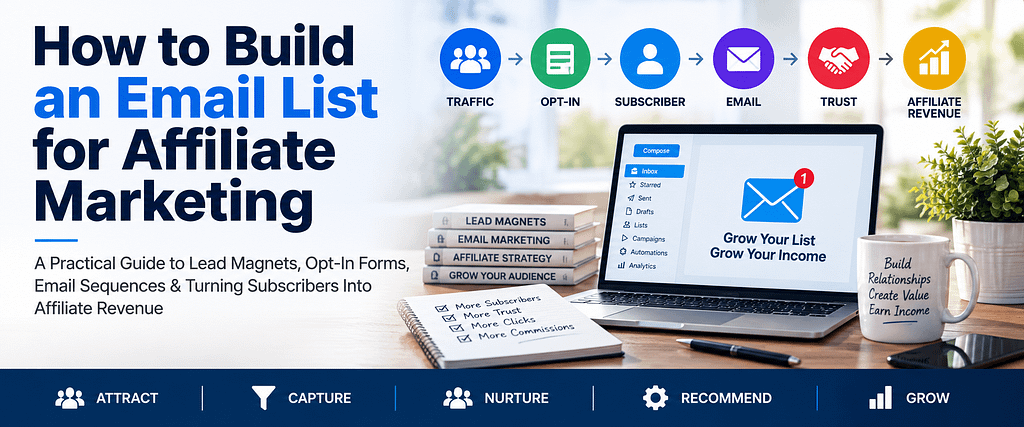
Why Email Lists Matter for Affiliate Marketers
Most people who visit your affiliate website will not purchase a product during their first visit. They may be researching, comparing options, learning about a problem, or simply not ready to make a decision yet.
If that visitor leaves and you have no way to reach them again, the relationship often ends there.
An email list changes that.
Instead of depending entirely on Google, YouTube, social media, Pinterest, or paid advertising to bring the same visitor back, email gives you a direct way to continue providing useful information after someone leaves your website.
For an affiliate marketer, that creates an important shift:
Traffic → Visitor → Subscriber → Relationship → Recommendation → Affiliate Revenue
You Own the Relationship
Search engines and social platforms can be excellent sources of traffic, but you do not control their algorithms, rankings, advertising costs, or platform policies.
Your email list is different.
When someone voluntarily subscribes, you gain permission to communicate with that person directly. You can send helpful content, introduce new resources, answer common questions, share product comparisons, and recommend relevant affiliate products without needing an algorithm to show every message.
That doesn’t mean you literally “own” your subscribers—the subscriber controls whether they remain on your list. What you control is the direct communication channel and the audience relationship you’ve built.
This is why an email list can become one of the most valuable long-term assets in an affiliate marketing business.
Key principle: Traffic brings people to your business. An email list gives you an opportunity to build a relationship with them after the first visit.
Turn One Visit Into Multiple Opportunities to Help
A visitor who clicks an affiliate link and leaves your website gives you one opportunity to earn a commission. A visitor who becomes an email subscriber gives you an opportunity to continue helping them over time.
That does not mean sending promotion after promotion. The value of email comes from continuing the conversation that originally brought the person to your website.
For example, someone who subscribes after reading a guide about building an affiliate website might later benefit from:
- A website launch checklist
- A keyword research tutorial
- A content creation guide
- An SEO strategy
- A comparison of useful marketing tools
- A relevant hosting, software, or service recommendation
One visitor can therefore become part of a longer customer journey:
Visitor → Subscriber → Helpful Emails → Trust → Multiple Relevant Recommendations → Long-Term Customer Value
Email Connects the Rest of Your Affiliate Business
Email should not operate as a separate marketing activity. It can connect the different parts of your affiliate business.
Your SEO content can generate subscribers.
Your YouTube videos can generate subscribers.
Your social media content can generate subscribers.
Your paid campaigns can generate subscribers.
And once those people join your list, email can direct them back to your best articles, comparisons, tutorials, reviews, and relevant affiliate recommendations.
Think of the system like this:
SEO + Social + Video + Paid Traffic → Website → Email List → Content + Recommendations → Affiliate Revenue
This is one reason we’re building email as part of the larger affiliate-marketing system rather than treating it as an isolated tactic.
Build Trust Before You Monetize
An email address is permission to communicate—not permission to bombard someone with offers.
Your first responsibility is to deliver what you promised when the person subscribed.
Then continue earning attention by sending useful information that helps subscribers solve problems and make better decisions.
As trust develops, affiliate recommendations can become a natural extension of that help.
Value → Consistency → Trust → Relevant Recommendation → Conversion
Email-list principle: Don’t build an email list simply to have more people to promote products to. Build an audience that trusts your information, benefits from your content, and values the recommendations you make.
What You’ll Learn
By the end of this guide, you’ll understand how to build an email list that becomes a useful long-term asset for your affiliate marketing business—not simply a collection of email addresses.
You’ll learn:
- Why an email list is valuable for affiliate marketers
- How to identify the right audience and email strategy
- How to create lead magnets people actually want
- How to build opt-in forms and landing pages that convert visitors into subscribers
- How to create a simple affiliate welcome sequence
- How to write emails that educate, build trust, and generate qualified clicks
- How to introduce affiliate recommendations without turning every email into a sales pitch
- How to segment subscribers based on interests and behavior
- How to measure list growth, engagement, clicks, conversions, and revenue
- How to create a practical 90-day plan for building and improving your email marketing system
The goal isn’t to build the biggest email list. It’s to build the right audience, earn their attention, and consistently send information worth opening.
In This Guide
- Why Email Lists Matter for Affiliate Marketers
- What You’ll Learn
- Chapter 1: Why Affiliate Marketers Need an Email List
- Chapter 2: Choose the Right Audience & Email Strategy
- Chapter 3: Create a Lead Magnet People Actually Want
- Chapter 4: Build High-Converting Opt-In Forms & Landing Pages
- Chapter 5: Create Your Affiliate Welcome Sequence
- Chapter 6: Write Emails That Build Trust & Generate Clicks
- Chapter 7: Grow, Measure & Optimize Your Email List
- Chapter 8: Build Your 90-Day Affiliate Email Plan
- Final Thoughts
- Recommended Next Reads
- Ready to Build Your Affiliate Marketing Business?
Chapter 1: Why Affiliate Marketers Need an Email List
Affiliate marketing often begins with traffic. You create useful content, attract visitors, and recommend products that can help solve their problems.
But traffic alone does not create a durable audience.
A visitor might discover your website through Google, read one article, click away, and never return. The same thing can happen with visitors from YouTube, Pinterest, Facebook, TikTok, or paid advertising.
Email gives you a way to turn some of those one-time visitors into people you can continue helping.
Traffic Is Temporary. Relationships Can Continue.
Imagine that 1,000 people visit one of your affiliate guides.
If they leave without subscribing, you must depend on search engines, social platforms, advertising, or another traffic source to reach them again.
But if some of those visitors join your email list, the economics begin to change.
Instead of:
Traffic → Visit → Leave
you can create:
Traffic → Visit → Subscribe → Follow-Up → Return Visit → Recommendation → Conversion
That means the value of your content is no longer limited to what happens during a single browsing session.
Reduce Your Dependence on Algorithms
Search engines and social platforms remain valuable parts of an affiliate marketing strategy. We are not trying to replace them.
We are trying to avoid depending entirely on them.
Search rankings can change. Social reach can fluctuate. Advertising costs can increase. Platforms can change their rules, features, or algorithms.
Your email list gives you another communication channel.
A stronger system looks like:
SEO + Social + Video + Paid Traffic → Website → Email List
Then:
Email List → Helpful Content → Website Visits → Product Recommendations → Affiliate Revenue
The traffic platforms help you discover the audience.
Email helps you continue the relationship.
Build an Audience, Not Just Website Traffic
This is the larger strategic difference.
Website traffic is a measurement.
An audience is a group of people who have chosen to continue hearing from you.
That audience can become increasingly valuable as you publish new tutorials, comparisons, reviews, tools, and resources.
Instead of starting from zero every time you publish something new, you have people you can invite back to your website.
Chapter 1 principle: Don’t use email to replace your traffic channels. Use your traffic channels to build an audience you can continue serving after the first visit.
Understand the Business Value of a Subscriber
Not every subscriber will click an affiliate link or purchase something, and that should not be the expectation.
The value comes from having repeated opportunities to provide useful information to people who have already shown an interest in your topic.
A subscriber might:
- Return to read several articles
- Download additional resources
- Click product comparisons
- Watch your tutorials
- Try a recommended tool
- Purchase through an affiliate link
- Make additional purchases later
- Share useful content with someone else
This creates something a single website visit cannot provide: multiple opportunities to create value over time.
Think of the difference this way:
One-Time Visitor → One Opportunity
versus:
Subscriber → Ongoing Relationship → Multiple Helpful Interactions → Multiple Relevant Opportunities
Recurring Affiliate Programs Can Increase Long-Term Value
Some affiliate programs pay only once when a customer purchases. Others offer recurring commissions when a referred customer continues paying for a subscription or service.
Email can work particularly well with products that require education before purchase or provide ongoing value after someone becomes a customer.
For example, software, marketing platforms, hosting services, and other subscription products may require several interactions before someone is ready to make a decision.
Instead of forcing the sale immediately, email allows you to:
Educate → Demonstrate → Compare → Answer Questions → Recommend
That can create a better experience for the subscriber while giving your affiliate recommendations more context.
List Quality Matters More Than List Size
A list of 1,000 highly relevant subscribers can be more valuable than a much larger list of people who have little interest in your content or recommendations.
Don’t judge success only by subscriber count.
Pay attention to whether subscribers:
- Continue opening and engaging with your emails
- Click through to useful content
- Respond to relevant offers
- Remain subscribed
- Match the audience your affiliate products are designed to serve
This is why buying email lists or chasing subscribers who have little connection to your niche is a poor foundation for an affiliate business.
Your goal is not:
Get the Most Subscribers
Your goal is:
Attract the Right People → Deliver Value → Earn Attention → Build Trust → Make Relevant Recommendations
Chapter 1 Takeaway: An email list becomes valuable because it gives you repeated opportunities to help the right audience. Focus on attracting relevant subscribers and building relationships—not simply increasing the number beside your subscriber count.
Chapter 2: Choose the Right Audience & Email Strategy
Before choosing an email platform, designing an opt-in form, or writing an automated sequence, decide who you want on your email list and why they should want to hear from you.
A successful affiliate email strategy begins with audience relevance.
If your website attracts people interested in several different topics, sending everyone the same emails can quickly reduce engagement. The more closely your emails match the subscriber’s original interests and goals, the more useful your messages become.
Start With the Audience Problem
Don’t begin by asking:
“What affiliate product can I promote?”
Begin with:
“What problem is this audience trying to solve?”
For an affiliate marketing website, those problems might include:
- Choosing a profitable niche
- Building an affiliate website
- Finding keywords
- Creating better content
- Generating traffic
- Using AI tools
- Building an email list
- Improving conversions
- Choosing profitable affiliate products
Once you understand the problem, you can build an email path around helping the subscriber solve it.
The sequence becomes:
Audience → Problem → Helpful Content → Email Subscription → Continued Education → Relevant Solution
Understand Why the Subscriber Joined
The page or resource that generated the subscriber gives you valuable information about what that person is interested in.
Someone who downloads an AI Prompt Toolkit is signaling a different immediate interest from someone who downloads an Affiliate Website Launch Checklist.
For example:
AI Guide → AI Lead Magnet → AI Subscriber → AI Tutorials → AI Tool Recommendations
SEO Guide → Keyword Worksheet → SEO Subscriber → SEO Lessons → SEO Tool Recommendations
Website Guide → Launch Checklist → Website Subscriber → Website Tutorials → Hosting or Website Tool Recommendations
This is much stronger than putting everyone into:
Subscriber → Generic Newsletter → Random Promotions
Choose the Primary Purpose of Your Emails
Your email program can accomplish several things:
Educate — Help subscribers understand the topic and solve problems.
Engage — Bring subscribers back to useful website content.
Nurture — Build familiarity and trust over time.
Recommend — Introduce products and services that fit subscriber needs.
Convert — Help subscribers who are ready to make a decision take the next step.
These goals work together.
A healthy affiliate email strategy generally moves through:
Educate → Engage → Nurture → Recommend → Convert
rather than:
Subscribe → Promote → Promote → Promote
Strategy principle: The best email strategy starts with the subscriber’s problem, not your affiliate link. Understand why someone joined your list, then continue helping them move toward the right solution.
Segment Subscribers by Interest
Segmentation means organizing subscribers into groups based on what you know about their interests, behavior, or where they entered your email list.
You do not need a complicated segmentation system when you’re starting.
Begin with something simple: track the topic or lead magnet that caused someone to subscribe.
For example:
AI Tools Content → AI Tools Segment
SEO Content → SEO Segment
Website Building Content → Website Segment
Traffic Content → Traffic Segment
Email Marketing Content → Email Marketing Segment
This allows you to send more relevant information instead of treating every subscriber as though they have exactly the same interests.
As your list grows, you can eventually segment based on additional behavior such as which links subscribers click, which resources they download, or which topics consistently interest them.
Choose a Sustainable Email Cadence
There is no universal rule saying affiliate marketers must email subscribers every day, three times per week, or once per week.
The better question is:
How often can you consistently send something worth receiving?
For many affiliate marketers, a manageable starting point might be one useful regular email per week, combined with automated welcome emails when someone first subscribes.
The important thing is consistency.
Avoid disappearing for months and suddenly returning only when you have something to promote.
A healthier pattern is:
Consistent Value → Familiarity → Trust → Relevant Offers
Start With a Simple Email System
When you’re starting from zero, you don’t need dozens of automations, complicated tagging rules, or multiple newsletters.
Start with:
1 Audience
↓
1 Relevant Lead Magnet
↓
1 Opt-In Form or Landing Page
↓
1 Welcome Sequence
↓
1 Regular Email
↓
Relevant Affiliate Recommendations
Get that system working before adding complexity.
As you learn what subscribers respond to, you can add more lead magnets, segments, automated sequences, and specialized campaigns.
Create an Email Promise
Subscribers should understand what they are signing up to receive.
Your email promise might be something like:
Practical affiliate marketing strategies, tools, and tutorials designed to help you build traffic, create better content, and grow affiliate revenue.
That promise becomes a filter for future emails.
Before sending something, ask:
Does this email help fulfill the reason people subscribed?
If the answer is no, reconsider whether it belongs in that subscriber’s inbox.
Chapter 2 Takeaway: Start simple. Identify the audience, understand why they subscribed, organize subscribers around their interests, and establish a communication rhythm you can sustain. Relevance and consistency matter more than complicated automation.
Chapter 3: Create a Lead Magnet People Actually Want
A lead magnet is something useful you offer visitors in exchange for permission to continue communicating with them by email.
But simply putting a free PDF behind an opt-in form does not make it valuable.
The strongest lead magnets solve a specific problem for a specific person and provide a result they can use quickly.
Solve One Specific Problem
Avoid creating something so broad that the visitor cannot immediately understand why they need it.
For example:
Too broad:
“Complete Guide to Making Money Online”
More specific:
“Affiliate Niche Profitability Checklist”
Or:
Too broad:
“SEO Guide”
More specific:
“25-Point Affiliate Keyword Research Worksheet”
Specificity makes the value easier to understand.
A useful formula is:
Specific Audience + Specific Problem + Useful Shortcut = Strong Lead Magnet
Match the Lead Magnet to the Content
The best lead magnet usually feels like the next logical step after the content the visitor is already consuming.
For our affiliate marketing site, examples could include:
Niche Selection Guide
→ Profitable Affiliate Niche Checklist
Affiliate Website Guide
→ Affiliate Website Launch Checklist
Keyword Research Guide
→ Keyword Research Worksheet
Affiliate Content Guide
→ Affiliate Article Planning Template
Traffic Guide
→ 90-Day Traffic Planner
AI Tools Guide
→ Affiliate Marketing AI Prompt Library
Email Marketing Guide
→ Affiliate Welcome Sequence Template
This creates:
Relevant Content → Relevant Lead Magnet → Relevant Subscriber
And that is far more valuable than collecting subscribers through an unrelated giveaway.
Choose the Right Lead Magnet Format
Your lead magnet doesn’t need to be a 50-page ebook.
In many cases, something shorter and more actionable is more useful.
Good formats include:
- Checklist
- Worksheet
- Template
- Cheat sheet
- Swipe file
- Planner
- Resource list
- Comparison chart
- Prompt library
- Mini-course
- Short video training
- Email course
- Calculator or simple tool
Choose the format based on what helps the visitor get the desired result most easily, not what looks the most impressive.
Lead-magnet principle: Don’t create the biggest free resource you can. Create the most useful shortcut to the next result your visitor already wants.
Put Your Lead Magnet Through the Value Test
Before publishing a lead magnet, ask these four questions:
1. Is the benefit immediately clear?
A visitor should understand within a few seconds what the resource will help them accomplish.
2. Does it solve a specific problem?
The narrower and more relevant the problem, the easier it is for the right visitor to recognize the value.
3. Can the subscriber use it quickly?
A checklist someone can use today may be more valuable than a long ebook they intend to read someday.
4. Does it naturally connect to what comes next?
Your lead magnet should create a logical bridge to your future emails, content, and recommendations.
A strong lead magnet passes this test:
Relevant → Specific → Useful → Actionable → Connected
Give the Lead Magnet a Benefit-Driven Name
The title matters.
Don’t describe only what the resource is. Tell visitors what it helps them do.
Instead of:
Affiliate Marketing Worksheet
consider:
The Profitable Affiliate Niche Worksheet
Instead of:
SEO Checklist
consider:
The 25-Point Affiliate SEO Checklist
Instead of:
Email Template
consider:
5-Email Affiliate Welcome Sequence Template
The visitor should be able to look at the title and quickly answer:
“Why would I want this?”
Connect the Lead Magnet to Future Affiliate Recommendations
A good lead magnet can also begin a natural path toward relevant products without turning the free resource into a disguised sales pitch.
For example:
Keyword Research Worksheet
→ Keyword Research Lessons
→ SEO Tool Comparison
→ Relevant SEO Tool Recommendation
Or:
Affiliate Website Launch Checklist
→ Website Setup Emails
→ Hosting Tutorial
→ Relevant Hosting Recommendation
Or:
AI Prompt Library
→ AI Content Tutorials
→ AI Tool Comparison
→ Relevant AI Tool Recommendation
The sequence should make sense even if the affiliate commission did not exist.
That’s an important test.
Ask:
“Would I still recommend this next step if I weren’t being paid for it?”
If the answer is yes, the recommendation is much more likely to fit naturally into the subscriber’s journey.
Don’t Overbuild Your First Lead Magnet
For your first email funnel, choose one high-value lead magnet connected to an important area of your site.
Create it, launch it, and measure how visitors respond.
You can always add more later.
The starting system should be:
High-Value Content → Specific Lead Magnet → Relevant Subscriber → Helpful Follow-Up → Relevant Recommendation
Chapter 3 Takeaway: A strong lead magnet doesn’t attract everybody. It attracts the right people by offering a useful solution to a specific problem—and creates a natural starting point for the email relationship that follows.
Chapter 4: Build High-Converting Opt-In Forms & Landing Pages
You can create an excellent lead magnet and still build your email list slowly if visitors don’t clearly understand what they’re getting, why it’s valuable, and what they need to do next.
Your opt-in form or landing page has one primary job:
Turn the right visitor into a subscriber.
That means removing unnecessary distractions and making the value of subscribing immediately clear.
Lead With the Benefit
The headline should communicate the result the visitor will receive—not simply announce that you have a newsletter.
Instead of:
Join Our Newsletter
try something specific such as:
Download the Free Affiliate Website Launch Checklist
or:
Get the 25-Point Affiliate Keyword Research Worksheet
A strong opt-in message answers:
What is it? → Who is it for? → How will it help me?
Keep the Form Simple
Don’t ask for information you don’t actually need.
For many affiliate marketing funnels, an email address is enough. You might also collect a first name if you have a genuine reason to personalize future messages.
Every additional field creates another decision for the visitor.
A simple form could contain:
Email Address
[ Get the Free Checklist ]
Then add a short reassurance beneath it:
We’ll send the resource to your inbox along with useful affiliate marketing tips. Unsubscribe anytime.
The CTA button should describe what happens next. That’s usually stronger than a generic button such as Submit.
Put Opt-In Forms Where Intent Is Strong
You don’t need to cover every page with pop-ups and subscription boxes.
Place opt-in opportunities where the offer naturally connects with what the visitor is already doing.
Good locations include:
- Near the end of a relevant article
- After an important educational section
- Inside a contextual resource box
- On a dedicated lead-magnet landing page
- Within a relevant tutorial
- After a comparison or buying guide when appropriate
- In the sidebar or footer as a secondary opportunity
For example:
Keyword Research Guide → Keyword Research Worksheet
is a much stronger transition than:
Keyword Research Guide → Generic Newsletter Form
Create a Dedicated Landing Page When It Helps
For important lead magnets—especially those promoted through social media, YouTube, or paid traffic—a dedicated landing page can keep the visitor focused on one action.
A simple structure is:
Headline → Benefit → What’s Included → Why It Helps → Opt-In Form → Reassurance
Avoid unnecessary navigation, unrelated offers, and multiple competing CTAs when the page’s primary purpose is email capture.
Opt-in principle: Make the value obvious, keep the form simple, and place the offer where it feels like the natural next step in the visitor’s journey.
Make the Opt-In Experience Mobile-Friendly
A large percentage of visitors may encounter your opt-in form on a phone, so don’t design only for desktop.
On mobile, make sure:
- The headline is easy to read
- The form fields are large enough to use comfortably
- The CTA button is obvious
- The page doesn’t require horizontal scrolling
- Pop-ups don’t cover important content
- The form loads quickly
- The visitor can easily close any overlay
Always test the actual opt-in process on both desktop and mobile before sending traffic to it.
Use the Thank-You Page Strategically
After someone subscribes, don’t end the experience with only:
“Thank you for subscribing.”
First, confirm the subscription and explain how they’ll receive the promised resource.
Then give them one logical next step.
For example:
Subscribe → Thank-You Page → Download Resource → Read Related Guide
Or:
Subscribe → Thank-You Page → Check Your Email → Start Welcome Sequence
When appropriate, you can also introduce a relevant tutorial, comparison, or resource—but delivering what you promised comes first.
Build Trust Around the Form
People are increasingly careful about giving websites their email addresses. Give them confidence about what will happen after they subscribe.
Clearly explain:
What they’ll receive → What kind of emails you’ll send → How often they can expect to hear from you
Include access to your privacy policy where appropriate, and make unsubscribing straightforward.
Avoid misleading opt-ins, pre-checked consent, or disguising what someone is signing up for.
The relationship should begin with clear expectations and genuine permission.
Measure Your Opt-In Conversion Rate
Once the form is receiving traffic, measure how effectively it turns visitors into subscribers.
Use:
Opt-In Conversion Rate = New Subscribers ÷ Visitors Who Saw the Offer × 100
For example:
500 visitors → 25 subscribers = 5% opt-in rate
Don’t chase a universal benchmark. Conversion rates vary significantly depending on traffic source, audience, placement, lead magnet, niche, and visitor intent.
Establish your own baseline and improve from there.
If qualified visitors are seeing the offer but aren’t subscribing, test one meaningful variable at a time:
Headline → Lead Magnet → CTA → Form → Placement → Page
Chapter 4 Takeaway: A strong opt-in experience makes the value clear, asks for only the information you need, works well on every device, establishes trust, and gives new subscribers an obvious next step.
Chapter 5: Create Your Affiliate Welcome Sequence
The moment someone joins your email list is one of the most important points in the relationship.
They have just shown interest in your content and trusted you with permission to contact them. Your welcome sequence should reinforce that decision by delivering what you promised and helping the subscriber take the next logical steps.
You do not need a complicated 20-email automation. A focused five-email welcome sequence is enough to build a strong foundation.
Email 1: Deliver What You Promised
Send the first email promptly after someone subscribes.
Its primary purpose is simple:
Deliver the lead magnet.
The email should:
- Welcome the new subscriber
- Provide the promised resource
- Explain briefly what they’ll receive from you
- Give them one useful next step
Avoid immediately filling the email with unrelated affiliate promotions.
The subscriber joined for a specific reason. Fulfill that promise first.
Email 2: Help Them Get a Quick Win
The second email should help the subscriber make progress with the problem that caused them to join.
For example:
Niche Checklist Subscriber
→ Show them how to eliminate weak niche ideas.
Keyword Worksheet Subscriber
→ Explain how to identify keywords with useful buyer intent.
AI Prompt Library Subscriber
→ Show them how to improve a basic prompt.
A quick win demonstrates that your emails contain information worth opening.
The relationship becomes:
Subscribe → Receive Resource → Get Result → Build Confidence
Email 3: Address a Common Problem or Mistake
Now help the subscriber avoid something that commonly prevents progress.
This could be:
- A common beginner mistake
- A misconception about the topic
- A strategy that wastes time
- A problem you’ve seen repeatedly
- An important step people often skip
For example:
“Why Choosing an Affiliate Niche Based Only on Commission Rates Can Backfire”
or:
“The Keyword Research Mistake That Attracts Traffic but Not Buyers”
This email should deepen the subscriber’s understanding while naturally preparing them for the solution you’ll introduce later.
Email 4: Introduce the Solution
By now you’ve delivered the promised resource and provided additional help.
This is a natural point to introduce a tool, product, strategy, or service that can help the subscriber move forward.
Don’t jump immediately to:
“Buy this.”
Instead explain:
The Problem → Available Solutions → What to Look For → Your Recommendation
If the recommended solution has an affiliate program, the affiliate link becomes part of a useful recommendation rather than the entire purpose of the email.
Welcome-sequence principle: Deliver value before asking for action. Each email should make the subscriber more confident that joining your list was a good decision.
Email 5: Help the Subscriber Make a Decision
The fifth email can help subscribers who are interested in the solution decide whether it is right for them.
Instead of simply repeating your affiliate link, answer the questions someone might have before taking action.
You might cover:
- Who the product is best for
- Who may not need it
- Important features
- Pros and cons
- Pricing considerations
- Alternatives
- Common questions
- Your experience or observations
- The specific problem the product solves
A useful structure is:
Problem → Options → Recommendation → Why It Fits → Clear Next Step
The goal is not to pressure every subscriber into buying. It is to help interested subscribers make a more informed decision.
Disclose Affiliate Relationships Clearly
When an email contains an affiliate recommendation, subscribers should understand that you may receive compensation if they purchase through your link.
Keep the disclosure clear and easy to understand.
For example:
Disclosure: This email contains affiliate links. I may earn a commission if you purchase through these links, at no additional cost to you.
The FTC provides guidance for marketers on clearly disclosing affiliate and other material relationships.
Transparency supports the trust you’re trying to build throughout the entire email relationship.
Space the Welcome Sequence Naturally
You don’t need to send all five emails immediately.
A simple starting schedule could be:
Day 0 — Email 1: Deliver the resource
Day 2 — Email 2: Provide a quick win
Day 4 — Email 3: Address a common mistake
Day 6 — Email 4: Introduce a solution
Day 8 — Email 5: Help them evaluate the recommendation
Those intervals are a starting framework, not a rigid rule. Adjust them based on your audience, topic, engagement, and the complexity of the buying decision.
What Happens After the Welcome Sequence?
The relationship shouldn’t end after Email 5.
Move subscribers into your regular email communication, where you continue sharing useful:
Guides → Tutorials → Strategies → Comparisons → Resources → Relevant Recommendations
This is where your email list becomes a long-term audience rather than a one-time automated campaign.
Your complete system now looks like:
Lead Magnet → Welcome Sequence → Trust → Relevant Recommendation → Regular Emails → Ongoing Relationship
Chapter 5 Takeaway: Your welcome sequence sets the tone for the entire subscriber relationship. Deliver what you promised, help subscribers make progress, introduce relevant solutions naturally, disclose affiliate relationships clearly, and continue providing value after the automation ends.
Chapter 6: Write Emails That Build Trust & Generate Clicks
Once your welcome sequence is complete, the challenge becomes keeping subscribers interested over the long term.
Successful affiliate email marketing is not about finding more ways to insert affiliate links. It is about consistently sending emails that subscribers find useful enough to open, read, and act on.
When subscribers trust the information you send, your recommendations carry more weight.
Give Every Email One Primary Purpose
Before writing an email, decide what you want it to accomplish.
An email might:
- Teach something useful
- Answer a common question
- Solve a specific problem
- Bring subscribers back to an article
- Share a new tutorial
- Compare two products
- Recommend a useful tool
- Help someone make a buying decision
Trying to accomplish all of those things in one email usually creates a scattered message.
Instead, think:
One Email → One Main Idea → One Primary Next Step
Write Subject Lines That Earn the Open
Your subject line should give subscribers a reason to pay attention without relying on misleading curiosity or exaggerated claims.
Compare:
Make $$$ With This Amazing Tool!!!
with:
3 Ways I Use AI to Research Affiliate Content
The second subject tells the subscriber what the email is about while still creating interest.
Useful subject-line approaches include:
Benefit:
How to Find Better Affiliate Keywords
Question:
Are You Targeting the Wrong Keywords?
Problem:
Why Your Affiliate Content Isn’t Getting Clicks
Specificity:
5 Steps for Improving Your Affiliate CTAs
Your subject line should accurately represent the email that follows.
Write for One Subscriber
Even if an email goes to thousands of people, write as though you’re communicating with one person.
Keep the writing conversational and easy to scan.
Use:
- Short paragraphs
- Clear language
- Useful examples
- Descriptive subheadings when needed
- Bullets for lists
- A clear next step
Avoid turning every email into a long sales letter.
The subscriber should quickly understand:
Why this matters → What they can learn → What they should do next
Make Affiliate Recommendations Contextual
The strongest affiliate links usually appear because the product is relevant to what you’re already teaching.
For example:
Email about keyword research
→ SEO or keyword-research tool
Email about building a website
→ Hosting or WordPress-related service
Email about AI content workflows
→ Relevant AI tool
Email about email automation
→ Email marketing platform
This creates:
Useful Topic → Relevant Problem → Appropriate Solution → Affiliate Recommendation
rather than:
Email List → Random Product Promotion
Email-writing principle: Write the useful email first. Then ask whether an affiliate recommendation genuinely improves the subscriber’s ability to solve the problem.
Give Every Email a Clear Call to Action
Once you’ve delivered the useful part of the email, make the next step easy to understand.
Your CTA might ask subscribers to:
Read the Guide → Watch the Tutorial → Compare the Tools → Download the Resource → See the Product → Learn More
Avoid several competing actions when one clear next step will do.
For example, instead of linking to five unrelated pages, build the email around one logical action:
Useful Email → Clear CTA → Relevant Page or Offer
The CTA should feel like a continuation of the email—not an interruption.
Balance Educational and Promotional Emails
There is no perfect formula for how many emails should educate versus promote.
Instead, use a better test:
Is this email useful to the subscriber?
An educational email can contain an affiliate link when it genuinely helps solve the problem. Likewise, a promotional email can still provide significant value when it explains who a product is for, how it works, its limitations, and possible alternatives.
Your email program should not feel like:
Promotion → Promotion → Promotion → Promotion
A healthier pattern is:
Teach → Help → Engage → Recommend → Help Again
Over time, subscribers should associate your name with useful information, not simply another sales message.
Protect the Trust You’ve Built
Trust can take months to develop and only a few poor recommendations to damage.
Before promoting an affiliate product, ask:
- Does it solve a real problem for this audience?
- Is it relevant to why these subscribers joined?
- Can I explain its advantages and limitations?
- Would I be comfortable recommending it without a commission?
- Does the offer support the promises I’ve made to my audience?
Don’t recommend a product merely because it pays a higher commission.
Your long-term reputation is more valuable than one affiliate conversion.
Don’t Overload Emails With Affiliate Links
More affiliate links do not automatically produce more revenue.
Too many links can distract subscribers from the action you actually want them to take.
Instead, keep the path simple:
Problem → Helpful Information → Relevant Solution → Clear CTA
When an affiliate link is used, disclose the relationship clearly and place the recommendation in context.
The objective is not to maximize the number of affiliate links inside each email.
It is to generate qualified clicks from subscribers who understand why the recommendation may help them.
Measure More Than Opens
Open rates can provide some directional information, but they are not a perfect measurement of engagement because privacy features and email-client behavior can affect tracking.
Pay attention to the broader picture:
Deliverability → Clicks → Website Visits → Affiliate Clicks → Conversions → Revenue
Also watch:
Unsubscribes → Spam Complaints → Bounces
Those signals can reveal when your frequency, targeting, content, or promotional approach needs adjustment.
Chapter 6 Takeaway: The best affiliate emails earn clicks by earning attention and trust first. Give each email a clear purpose, make recommendations relevant, use focused CTAs, and protect the subscriber relationship instead of maximizing short-term promotions.
Chapter 7: Grow, Measure & Optimize Your Email List
Once your lead magnet, opt-in system, welcome sequence, and regular emails are working together, the next goal is not simply to collect more subscribers.
You want to build a healthy email audience that continues growing while producing meaningful engagement and affiliate revenue.
That requires three things:
Grow → Measure → Improve
Grow Your List From Traffic You Already Have
Before spending money to acquire subscribers, make better use of the visitors already reaching your website.
Look for high-traffic and high-intent pages where an email offer naturally fits.
For example:
Niche Guide → Niche Selection Checklist
Keyword Research Guide → Keyword Research Worksheet
Affiliate Content Guide → Article Planning Template
AI Guide → AI Prompt Library
Website Guide → Website Launch Checklist
This turns existing content into an email-list-building system:
Search + Social + Video + Referrals → Helpful Content → Relevant Lead Magnet → Subscriber
As your content library grows, more pages can become entry points into your email audience.
Promote Lead Magnets Across Multiple Traffic Channels
Your website doesn’t have to be the only source of subscribers.
A useful lead magnet can also be promoted through:
- YouTube descriptions
- Social media content
- Relevant online communities where promotion is permitted
- Paid advertising when appropriate
- Guest content
- Partnerships
- Your existing email subscribers
- Calls to action inside downloadable resources
The important principle is message match.
Someone clicking from an SEO tutorial should arrive at an SEO-related offer—not an unrelated generic newsletter page.
Think:
Traffic Source → Visitor Intent → Relevant Offer → Subscription
Measure the Health of Your Email List
Subscriber count is useful, but it doesn’t tell you whether the list is actually helping your business.
Track a small group of meaningful metrics:
Subscriber Growth
How many relevant subscribers are joining over time?
Opt-In Conversion Rate
What percentage of qualified visitors become subscribers?
Click Rate
Are subscribers taking action on your emails?
Unsubscribe Rate
Are people leaving after particular topics or promotions?
Bounce Rate
Are your emails reaching valid addresses?
Affiliate Clicks & Conversions
Are relevant emails contributing to meaningful affiliate actions?
Revenue Per Subscriber
How much affiliate revenue is the email audience producing relative to its size?
The goal is to understand the complete journey:
Visitor → Subscriber → Engaged Reader → Qualified Click → Conversion → Revenue
Don’t Judge Success by List Size Alone
A list of 2,000 highly relevant subscribers can be more valuable than a much larger audience that rarely opens, clicks, or trusts the recommendations being sent.
This is why growth and quality have to work together.
Your objective is not:
Get as many email addresses as possible.
It is:
Attract the Right Subscribers → Keep Them Engaged → Help Them Progress → Make Relevant Recommendations
Optimization principle: Don’t grow your email list just to make the subscriber number bigger. Build an audience that consistently engages with your content and benefits from the recommendations you send.
Find the Weakest Point in Your Email Funnel
When results aren’t improving, don’t change everything at once.
Look at each stage:
Traffic → Opt-In → Welcome Sequence → Email Engagement → Affiliate Click → Conversion
Then identify where the biggest drop-off is occurring.
For example:
Good traffic + low opt-ins
→ Improve the lead magnet, headline, form, or placement.
Good opt-ins + low email clicks
→ Improve topics, relevance, CTAs, or subscriber segmentation.
Good email clicks + low affiliate conversions
→ Reevaluate the product, audience fit, buying intent, or recommendation.
Optimization becomes much easier when you’re fixing a specific problem instead of redesigning the entire system.
Test One Meaningful Variable at a Time
If you change the headline, lead magnet, form, CTA, email copy, and offer simultaneously, you won’t know what caused the result.
Instead:
Measure → Identify Weak Point → Change One Variable → Measure Again → Keep or Adjust
Useful elements to test include:
- Lead-magnet headline
- CTA wording
- Opt-in placement
- Landing-page copy
- Email subject line
- Email topic
- Recommendation
- Email frequency
Prioritize changes that could meaningfully improve the subscriber experience—not tiny adjustments simply because they’re easy to test.
Maintain a Healthy Email List
A bigger database isn’t automatically a better email list.
Over time, some subscribers may stop engaging, addresses may become invalid, and others may no longer be interested in your topic.
Monitor:
Bounces → Unsubscribes → Spam Complaints → Long-Term Inactivity
Use your email platform’s tools and current guidance to manage inactive subscribers and invalid addresses appropriately.
Also make unsubscribing easy.
Someone who no longer wants your emails should be able to leave without friction. Keeping uninterested subscribers doesn’t strengthen your business.
Improve Revenue by Improving Relevance
When affiliate revenue from email is disappointing, the answer isn’t automatically to send more promotions.
First examine the match between:
Subscriber → Problem → Email → Recommendation → Product
The closer those pieces align, the stronger your opportunity for qualified clicks and conversions.
For example:
SEO Subscriber → Keyword Tutorial → SEO Tool Comparison → Relevant SEO Product
is naturally stronger than:
SEO Subscriber → Unrelated Product Promotion
This is another reason segmentation becomes increasingly valuable as your list grows.
Build a Simple Optimization Dashboard
You don’t need dozens of reports.
Track a small set of numbers consistently:
New Subscribers → Opt-In Rate → Email Clicks → Affiliate Clicks → Conversions → Revenue → Unsubscribes
Then review trends over time rather than reacting to every individual email.
Your optimization cycle becomes:
Measure → Find Weak Point → Improve → Test → Learn → Scale
Chapter 7 Takeaway: Sustainable email growth comes from attracting relevant subscribers, measuring the entire journey, and improving the weakest parts of the system. Optimize for engaged subscribers and profitable relationships—not the largest possible list.
Chapter 8: Build Your 90-Day Affiliate Email Plan
You now have the individual pieces of an affiliate email system. The final step is turning them into a realistic plan you can actually execute.
You don’t need dozens of lead magnets, complicated automations, or thousands of subscribers before email marketing becomes useful.
For the next 90 days, focus on building one complete system from traffic to subscriber to recommendation.
Days 1–30: Build the Foundation
During the first month, establish the basic strategy and create the assets your system needs.
Focus on:
- Define your target subscriber
- Identify the main problem you’re helping them solve
- Choose one strong lead magnet
- Create the lead magnet
- Choose your email marketing platform
- Create your primary subscriber list or audience
- Set up basic segmentation or tagging
- Write your email promise
- Identify the content that will promote the lead magnet
Your first-month framework is:
Audience → Problem → Lead Magnet → Email Platform → Content → Opt-In Strategy
Don’t try to build everything simultaneously.
By the end of Day 30, you should know exactly who you’re trying to attract, why they should subscribe, and what they’ll receive when they do.
Days 31–60: Build & Connect the System
Now connect the pieces.
Create:
- Your opt-in form
- Your lead-magnet landing page if needed
- Your thank-you page
- Your five-email welcome sequence
- Your affiliate disclosures
- Your regular email template
- Tracking for important clicks and conversions
Then connect the entire journey:
Traffic → Content → Lead Magnet → Opt-In → Welcome Sequence → Helpful Emails → Relevant Recommendation
Test the system yourself from beginning to end.
Subscribe using a test email address and confirm:
Form Works → Email Arrives → Lead Magnet Opens → Links Work → Automation Continues → Mobile Experience Works
Do not start aggressively promoting the funnel until you’ve completed this test.
Days 61–90: Grow, Measure & Optimize
Once the system works, start increasing qualified traffic to it.
During this phase:
- Add relevant opt-ins to existing content
- Promote the lead magnet through appropriate traffic channels
- Send useful regular emails
- Monitor subscriber growth
- Measure opt-in performance
- Review email clicks
- Track affiliate clicks and conversions
- Identify your weakest funnel stage
- Improve one meaningful variable at a time
- Expand what is producing results
Your final 90-day framework becomes:
DAYS 1–30: BUILD
Audience → Problem → Lead Magnet → Platform → Content
DAYS 31–60: CONNECT
Opt-In → Welcome Sequence → Follow-Up → Recommendation
DAYS 61–90: OPTIMIZE
Measure → Find Weak Point → Improve → Test → Learn → Scale
And underneath it:
BUILD → CONNECT → MEASURE → IMPROVE → GROW
90-Day Principle: Don’t spend three months building the perfect email marketing system. Build a simple working system, put real subscribers through it, measure what happens, and improve it based on actual results.
What Happens After 90 Days?
At the end of 90 days, don’t automatically start over or build a more complicated funnel.
First, review what you’ve learned.
Ask:
- Which pages generate the most subscribers?
- Which lead magnet attracts the most relevant subscribers?
- Which emails generate the strongest engagement?
- Which topics produce qualified affiliate clicks?
- Which recommendations generate conversions?
- Where are subscribers dropping out of the funnel?
- Which parts of the system deserve more traffic?
Then make a simple decision:
Keep → Improve → Replace → Expand
Keep what is working.
Improve areas showing potential.
Replace elements that consistently underperform.
Expand successful lead magnets, content topics, email sequences, and affiliate recommendations.
Over time, your first simple email funnel can develop into a larger system:
Traffic Sources → Content Library → Multiple Lead Magnets → Segmented Subscribers → Relevant Email Sequences → Affiliate Recommendations → Long-Term Revenue
But complexity should come after results, not before them.
Chapter 8 Takeaway: Your first 90 days should produce a working email system—not a perfect one. Build the foundation, connect the subscriber journey, measure real behavior, and expand only after you know what your audience responds to.
Final Thoughts
Building an email list changes affiliate marketing from a business that depends entirely on the next visitor into one that can continue helping people after they leave your website.
The system we’ve built throughout this guide is straightforward:
Attract → Capture → Deliver Value → Nurture → Recommend → Measure → Improve
You don’t need thousands of subscribers before this becomes valuable.
Start with the right audience. Create one useful lead magnet. Build one dependable welcome sequence. Send emails worth opening. Recommend products when they genuinely fit the subscriber’s needs.
Then improve the system using what your subscribers actually do—not what you assume they’ll do.
The most valuable email list isn’t necessarily the largest.
It’s the one where subscribers trust your information, engage with your content, and value your recommendations.
The goal isn’t simply to collect email addresses. Build an audience you can continue helping—and create a marketing asset that becomes more valuable as your affiliate business grows.
Recommended Next Reads
How to Create Affiliate Content That Ranks, Helps & Converts
Learn how to create the content that attracts potential subscribers in the first place.
How to Drive Traffic to Your Affiliate Content
Build sustainable traffic from SEO, social media, video, Pinterest, email, and other channels.
How to Build an Affiliate Marketing Funnel That Converts
Connect your traffic, lead capture, email follow-up, recommendations, and conversions into one system.
How to Choose & Promote Profitable Affiliate Products
Learn how to evaluate offers and choose products that genuinely fit your audience.
Ready to Build Your Affiliate Marketing Business?
You’ve now built the email component. The next step is connecting it with the rest of your affiliate marketing system.
Build the foundation. Attract the right audience. Grow your email list. Earn trust. Recommend the right products. Optimize what works.
Use the AI-assisted funnel guide to connect the signup resource, delivery page, and initial emails. The prompt library includes an email-sequence brief you can adapt and verify.