
How to Choose & Promote Profitable Affiliate Products
A Practical Guide to Finding the Right Offers, Evaluating Affiliate Products & Matching Them to Your Audience
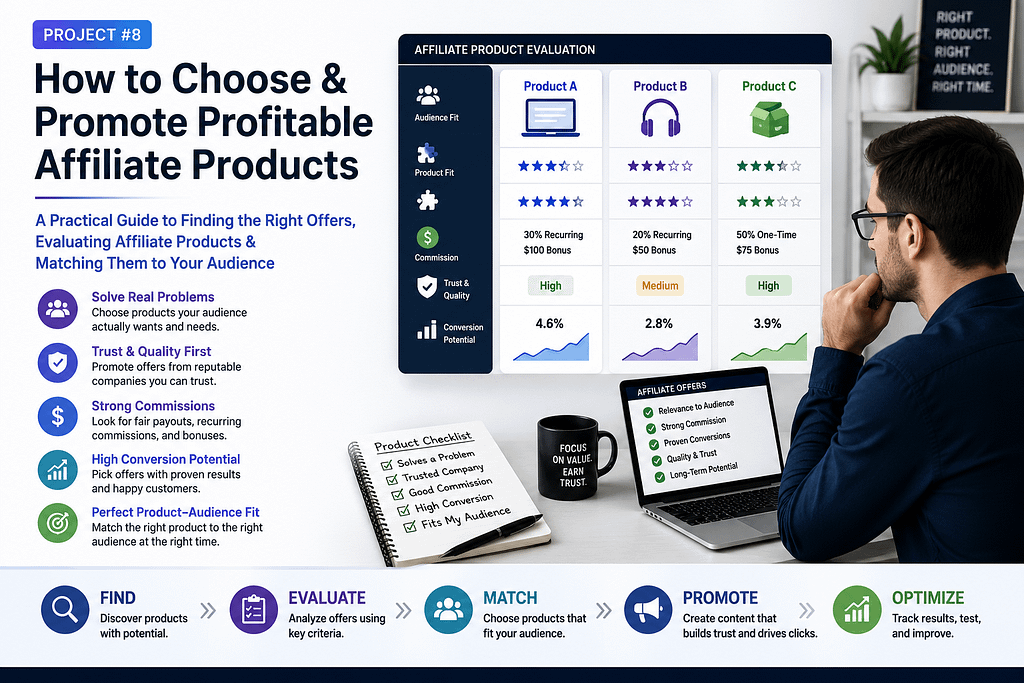
How to Choose Affiliate Products Worth Promoting
Choosing an affiliate product shouldn’t start with the commission rate. It should start with your audience.
The best affiliate products solve a real problem, fit naturally with your content, come from companies you can trust, and give your audience a clear reason to take action. A high commission means very little if the product is a poor fit or doesn’t convert.
In this guide, you’ll learn how to find promising affiliate products, evaluate offers before promoting them, compare commission structures, judge product quality and conversion potential, and match the right offers to the right content.
The goal isn’t to promote more products. It’s to build a smaller, stronger portfolio of offers you can confidently recommend.
What You’ll Learn in This Guide
By the end of this guide, you’ll know how to evaluate affiliate products before promoting them, identify offers that fit your audience, compare commission structures, and avoid products that could damage your credibility.
Find the Right Affiliate Products
Discover where to look for relevant products and programs without choosing offers simply because they pay high commissions.
Evaluate Product Quality & Trust
Look at reputation, customer experience, support, refund policies, and other signals before putting your name behind an offer.
Judge Conversion Potential
Evaluate pricing, landing pages, free trials, guarantees, sales processes, and other factors that influence whether referred visitors become customers.
Evaluate Audience & Product Fit
Determine whether a product actually solves a problem your audience has and fits naturally with your content.
Compare Commission Structures
Understand one-time versus recurring commissions, payout amounts, cookie duration, bonuses, and other terms that affect earning potential.
Build a Profitable Product Portfolio
Create a focused mix of affiliate offers that serves your audience instead of filling your site with unrelated promotions.
DIFFICULTY
Beginner–Intermediate
ESTIMATED TIME
45–60 Minutes
BEST FOR
Affiliate Marketers Ready to Choose Better Offers
WHAT YOU’LL CREATE
Your Affiliate Product Evaluation & Promotion Plan
- How to Choose & Promote Profitable Affiliate Products
- How to Choose Affiliate Products Worth Promoting
- What You’ll Learn in This Guide
- Chapter 1: Find the Right Affiliate Products
- Chapter 2: Match Products to Your Audience
- Chapter 3: Evaluate Product Quality & Trust
- Chapter 4: Compare Affiliate Commission Structures
- Chapter 5: Judge a Product’s Conversion Potential
- Chapter 6: Build a Profitable Affiliate Product Portfolio
- Chapter 7: Promote Affiliate Products Without Losing Trust
- Chapter 8: Build Your Affiliate Product Evaluation & Promotion Plan
- Related Guides
Chapter 1: Find the Right Affiliate Products
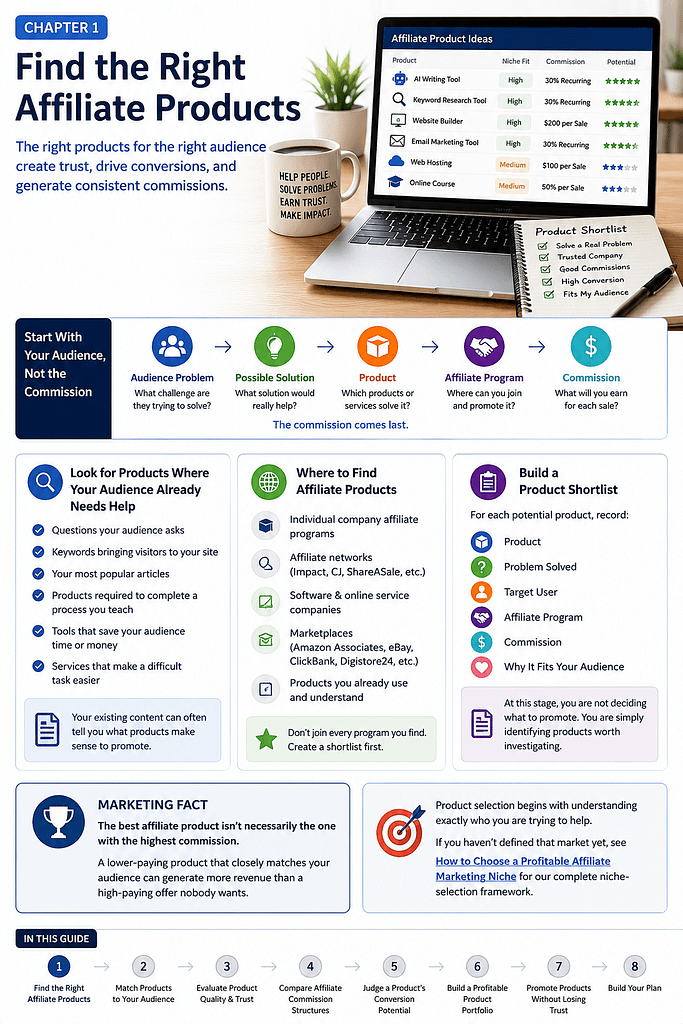
Finding affiliate products is easy. Finding the right products for your audience is much more important.
A high commission does not automatically make an offer worth promoting. The strongest affiliate products solve a real problem for your audience, fit naturally with your content, come from reputable companies, and give you a realistic opportunity to earn commissions.
Before joining another affiliate program, start with one question:
What products or services would genuinely help the people who visit my website?
Start With Your Audience, Not the Commission
One of the biggest mistakes affiliate marketers make is choosing products based primarily on how much they pay.
Instead, work in this order:
Audience Problem → Possible Solution → Product → Affiliate Program → Commission
The commission comes last.
For example, if your audience wants to create better affiliate content, relevant products might include AI writing tools, keyword research software, website tools, email platforms, or other services that directly support that goal.
Look for Products Where Your Audience Already Needs Help
Review the topics you already teach and the problems your visitors are trying to solve.
Look at:
- Questions your audience asks
- Keywords bringing visitors to your site
- Your most popular articles
- Products required to complete a process you teach
- Tools that save your audience time or money
- Services that make a difficult task easier
Your existing content can often tell you what products make sense to promote.
Where to Find Affiliate Products
You can find potential offers through individual company affiliate programs, affiliate networks, software companies, online services, marketplaces, and products you already use or understand.
But don’t join every program you find.
Create a shortlist first. Later in this guide, we’ll evaluate those products for audience fit, quality, commissions, and conversion potential.
Build a Product Shortlist
For each potential product, record:
Product → Problem Solved → Target User → Affiliate Program → Commission → Why It Fits Your Audience
At this stage, you are not deciding what to promote. You are simply identifying products worth investigating.
Marketing Fact
The best affiliate product isn’t necessarily the one with the highest commission.
A lower-paying product that closely matches your audience can generate more revenue than a high-paying offer nobody wants.
Product selection begins with understanding exactly who you are trying to help. If you haven’t defined that market yet, see How to Choose a Profitable Affiliate Marketing Niche for our complete niche-selection framework.
Chapter 2: Match Products to Your Audience
Finding the Right Affiliate Products Based on Audience Fit, Product Quality, and Commission Potential
Finding affiliate products is easy. Finding the right products for your audience is where profitable affiliate marketing begins.
A strong affiliate offer sits at the intersection of three things: audience fit, product quality, and commission potential. If one of those is missing, even an attractive affiliate program may not be worth promoting.
A high commission cannot compensate for a product your audience doesn’t need. Likewise, an excellent product may generate little revenue if it doesn’t match the problems your visitors are actively trying to solve.
Start With Audience Fit
Before looking at commission rates, ask one simple question:
Does this product genuinely help the people who visit my website?
Your best affiliate products should connect naturally with the topics you already teach and the problems your audience wants to solve.
For example, an affiliate marketing audience might reasonably need:
- Website hosting and WordPress tools
- Keyword research and SEO software
- AI writing and content-creation tools
- Email marketing platforms
- Landing-page and funnel builders
- Analytics and optimization tools
The closer the product is to your audience’s existing goals, the less convincing you have to do.
Evaluate Product Quality
Next, determine whether you would feel comfortable recommending the product even if there were no commission attached.
Look at the product’s reputation, usefulness, customer experience, reliability, support, and whether it actually delivers what its marketing promises.
Protecting your reader’s trust is more valuable than earning one commission from a questionable product.
Webmaster Tip: Never recommend a product solely because it pays well. Every recommendation affects the credibility of your entire website.
Consider Commission Potential
Once audience fit and product quality are established, evaluate the financial opportunity.
Look beyond the headline commission percentage. Consider the product’s price, conversion potential, cookie duration, recurring commissions, bonuses, refund rates, and the likelihood that your audience will actually purchase it.
For example, a 50% commission sounds impressive—but 50% of a product nobody buys earns nothing. A trusted product paying 20% that converts consistently may become far more profitable.
Use the Three-Part Product Test
Before adding an affiliate product to your promotion strategy, evaluate it against these three questions:
1. Audience Fit — Does it solve a real problem my audience has?
2. Product Quality — Is it something I can confidently recommend?
3. Commission Potential — Can promoting it realistically produce worthwhile revenue?
The strongest opportunities score well in all three areas.
Chapter 2 Takeaway
Don’t choose affiliate products based on commission alone. Choose products your audience needs, that you trust, and that provide enough earning potential to justify promoting them.
For the Chapter 2 graphic, we should visually build around:
AUDIENCE FIT + PRODUCT QUALITY + COMMISSION POTENTIAL → RIGHT AFFILIATE PRODUCT
Chapter 3: Evaluate Product Quality & Trust
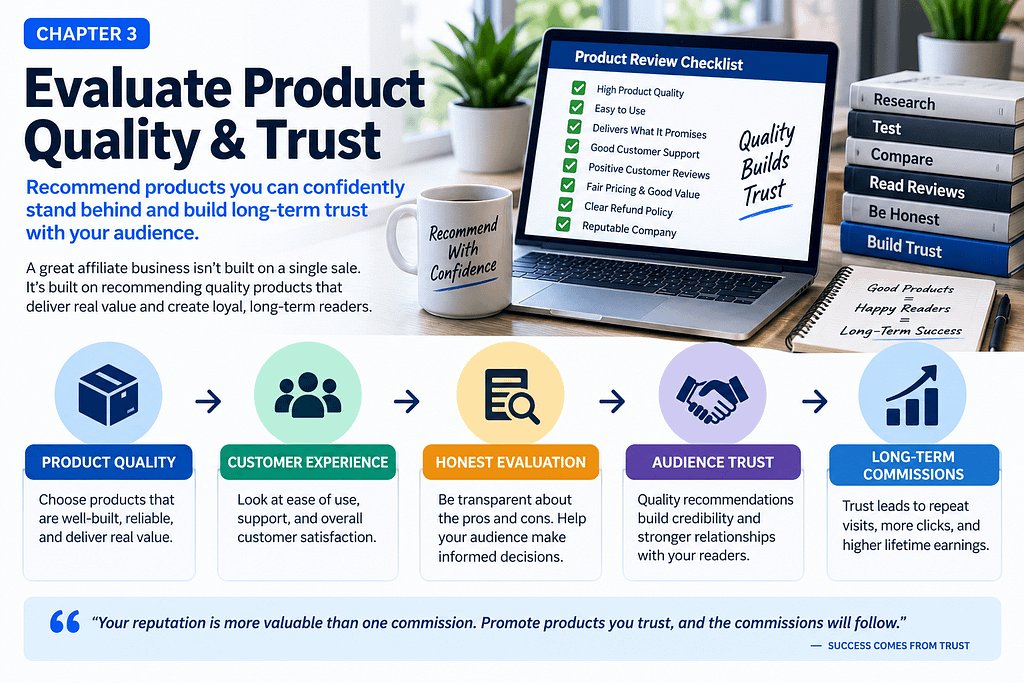
Finding a product that matches your audience is only the beginning. Before you recommend it, you need to determine whether the product is good enough to put your reputation behind.
Every affiliate recommendation creates a connection between the product and your brand. If the product delivers a great experience, your audience is more likely to trust your future recommendations. If it disappoints them, that trust can disappear quickly.
Your Reputation Is More Valuable Than One Commission
Transparency matters, too. The FTC recommends that affiliate marketers clearly disclose their relationship with brands when they may earn a commission from a recommendation.
Affiliate marketers sometimes focus too heavily on payouts. But long-term affiliate businesses are built on repeat trust, not individual transactions.
Before promoting a product, ask yourself:
Would I still feel comfortable recommending this product if I weren’t receiving a commission?
If the answer is no, it probably doesn’t belong on your website.
Evaluate the Product Before You Promote It
Whenever possible, use the product yourself. A free trial, demo, sample, or basic plan can tell you far more than reading an affiliate sales page.
Look closely at:
- Overall product quality and usefulness
- Ease of use and customer experience
- Whether the product delivers what it promises
- Customer support and documentation
- Pricing and value for money
- Refund or cancellation policies
- Reputation among actual customers
- Whether the company appears reliable and established
You don’t need every product to be perfect. You do need to understand its strengths and weaknesses well enough to make a responsible recommendation.
Look Beyond the Sales Page
Affiliate sales pages are designed to convert visitors. Your job is to investigate what happens after the purchase.
Read independent customer feedback, examine support resources, test important features when possible, and look for recurring complaints.
A few negative reviews aren’t necessarily a problem. Every established product receives criticism. What matters is whether you see consistent problems involving billing, poor support, misleading claims, difficult cancellations, or a product that repeatedly fails to deliver.
Be Honest About Pros and Cons
Trust increases when readers can see that you’re helping them make a decision rather than simply trying to generate a commission.
Don’t present every affiliate product as perfect.
Explain:
Who it’s best for.
What it does particularly well.
Where it falls short.
Who probably shouldn’t buy it.
That approach may occasionally cost you a click, but it can dramatically strengthen the credibility of your recommendations over time.
Trust Compounds
A visitor who trusts one recommendation may return when they need another tool, product, or service.
That means a trustworthy recommendation can produce value far beyond the first commission:
Good Recommendation → Positive Experience → Greater Trust → Future Recommendations → Repeat Commissions
This is why protecting your reputation should always come before maximizing an individual payout.
Chapter 3 Takeaway
Promote products you can confidently stand behind. Your audience’s trust is an asset that can generate commissions for years—protect it more carefully than any single affiliate sale.
Chapter 4: Compare Affiliate Commission Structures
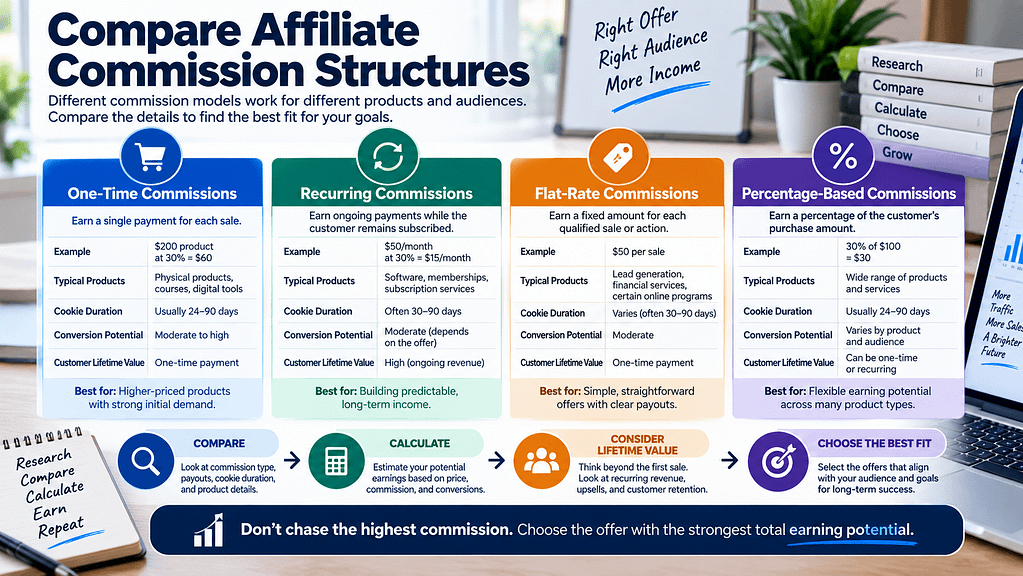
Not all affiliate commissions are created equal. A high commission percentage may look attractive, but the best affiliate offer is the one that combines strong earning potential, realistic conversions, and long-term value.
Understand the Main Commission Models
One-Time Commissions
You earn a single payment when someone purchases through your affiliate link. These are common with physical products, courses, and many digital products.
Recurring Commissions
You continue earning as long as the customer remains subscribed. This model is common with software, memberships, and subscription services and can help build more predictable affiliate income.
Flat-Rate Commissions
You receive a fixed amount for each qualified sale or action—for example, $50 per sale—regardless of the purchase price.
Percentage-Based Commissions
You earn a percentage of the customer’s purchase. A 30% commission on a $200 product would generate a $60 commission.
Look Beyond the Commission Rate
Never choose an affiliate product based on commission percentage alone. Compare:
- Average order value — How much does the typical customer spend?
- Conversion potential — How likely is your audience to buy?
- Recurring revenue — Can one referral generate multiple commissions?
- Cookie duration — How long after the click can you receive credit?
- Refund rate — High refunds can reduce actual earnings.
- Upsells and bonuses — Do additional purchases increase your commission?
- Payout terms — When and how will you be paid?
Compare Real Earning Potential
Consider two offers:
Product A: $200 price × 30% commission = $60 per sale
Product B: $50/month × 30% recurring commission = $15 per month
Product A produces more money immediately. But if a Product B customer remains subscribed for 12 months, that referral could generate $180.
Neither structure is automatically better. The right choice depends on your audience, the product, customer retention, and how well the offer converts.
Best Practice: Evaluate the entire commission structure—not just the percentage advertised on the affiliate signup page.
The Rule to Remember
Audience Fit + Conversion Rate + Commission Value + Customer Lifetime Value = Real Affiliate Earning Potential
A lower-paying offer that converts consistently and keeps customers can be more profitable than a high-paying offer that rarely converts.
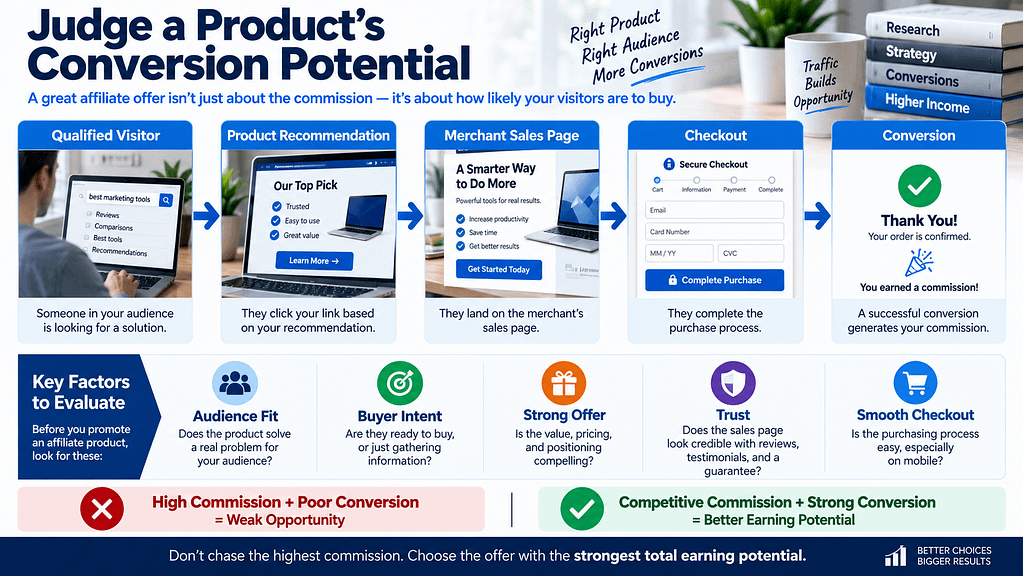
Chapter 5: Judge a Product’s Conversion Potential
A product can offer a generous commission and still be a poor affiliate opportunity if visitors rarely buy it. Conversion potential is the likelihood that qualified visitors will move from your recommendation to the merchant’s page and complete the desired action.
Look Beyond the Commission Rate
A $150 commission sounds better than a $40 commission, but the higher-paying offer is not automatically more profitable.
For example:
Product A: $150 commission × 1% conversion rate = $1.50 expected revenue per qualified visitor
Product B: $40 commission × 5% conversion rate = $2.00 expected revenue per qualified visitor
Product B pays less per sale but could produce more revenue because it converts more effectively.
Evaluate the Product’s Sales Process
Before promoting an offer, examine what happens after someone clicks your affiliate link. Look at the merchant’s landing page as if you were the customer.
Pay attention to:
- Clear value proposition — Is it immediately obvious what the product does and why someone should want it?
- Professional sales page — Does the page look trustworthy, current, and easy to navigate?
- Strong product presentation — Are the features and benefits explained clearly?
- Social proof — Are there credible reviews, testimonials, ratings, or case studies?
- Clear pricing — Can visitors easily understand what they’ll pay?
- Low-friction checkout — Is purchasing straightforward, especially on mobile?
- Guarantee or return policy — Does the company reduce the customer’s perceived risk?
Match the Offer to Buyer Intent
Conversion potential also depends on when you introduce the product.
Someone reading “What is affiliate marketing?” probably isn’t ready to purchase an advanced $500 marketing platform. But someone searching “Best affiliate marketing software for WordPress” may be much closer to making a buying decision.
The closer your product recommendation matches the visitor’s problem, intent, and stage in the buying journey, the greater its conversion potential.
Watch for Conversion Red Flags
Be cautious when an affiliate offer has an impressive payout but the customer experience creates unnecessary friction. Warning signs include confusing sales pages, unclear pricing, exaggerated claims, outdated websites, poor mobile usability, weak customer reviews, or complicated checkout processes.
A high commission cannot compensate for an offer your audience doesn’t trust or want.
Webmaster Tip
Think beyond “How much do I earn per sale?” Ask, “How likely is my audience to buy this product after I recommend it?” The best affiliate offers combine strong audience fit, competitive commissions, and a sales process capable of converting qualified visitors.
Conversion Potential Formula
Use this simple framework when comparing offers:
Audience Fit + Buyer Intent + Strong Offer + Trust + Smooth Sales Process = Higher Conversion Potential
The goal isn’t to find the product with the biggest commission. It’s to find the product with the strongest overall earning potential for your audience.
Chapter 6: Build a Profitable Affiliate Product Portfolio
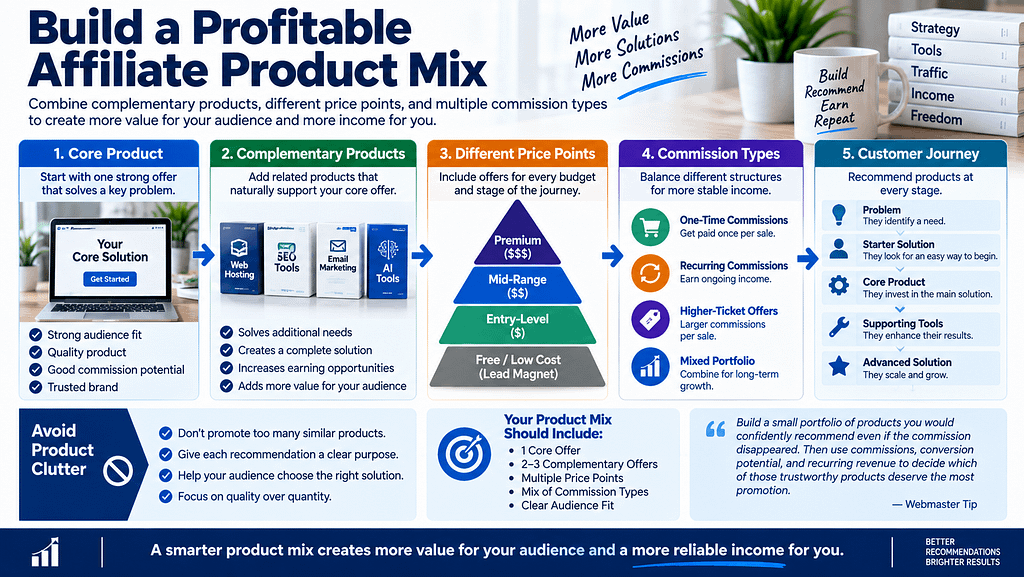
Successful affiliate marketers rarely depend on a single product. A stronger strategy is to build a product mix—a carefully selected group of offers that solves different problems, serves customers at different stages, and creates multiple opportunities to earn commissions.
The goal isn’t to promote as many products as possible. It’s to create a focused portfolio of complementary offers that makes sense for your audience.
Start With One Core Product
Choose one strong product that solves an important problem for your audience. This becomes your core affiliate offer and should have strong audience fit, good product quality, reasonable commission potential, and a trustworthy sales process.
Your core product gives your affiliate strategy a foundation instead of forcing you to promote unrelated offers simply because they pay well.
Add Complementary Products
Next, look for products that naturally support the core offer.
For example, an affiliate marketer promoting a website-building platform might also recommend:
Web Hosting → WordPress Tools → SEO Software → Email Marketing → AI Content Tools
Each product solves a different part of the customer’s larger problem. Together, they create a useful ecosystem rather than a collection of random affiliate links.
Include Different Price Points
Not every visitor has the same budget or level of commitment. A healthy product mix can include:
- Entry-level offers — affordable products that are easy for beginners to try.
- Mid-range offers — stronger solutions for people ready to invest more.
- Premium offers — advanced products or services for serious buyers.
- Recurring offers — subscriptions that can generate ongoing commissions.
This allows you to serve visitors at several stages of their journey without forcing every reader toward the same purchase.
Balance Commission Types
Your affiliate income can also become more stable when you combine different commission structures.
A one-time commission can generate immediate revenue, while recurring programs can continue producing income as long as referred customers remain subscribed.
You might build a mix such as:
One-Time Commissions + Recurring Commissions + Higher-Ticket Offers = Diversified Affiliate Revenue
Don’t choose a product simply to fill one of these categories. Audience fit and product quality still come first.
Avoid Affiliate Product Clutter
More offers do not automatically mean more revenue.
Promoting too many similar products can confuse visitors and weaken your recommendations. If you list ten nearly identical tools without explaining which one is best for whom, you’re forcing the reader to make the decision alone.
Instead, give each recommendation a clear purpose:
Best Overall | Best for Beginners | Best Value | Best for Advanced Users | Best for a Specific Need
Your job as an affiliate marketer is to simplify the buying decision, not make it harder.
Build Around the Customer Journey
Think about what your visitor might need before, during, and after purchasing your primary recommendation.
A simple product ecosystem might look like:
Problem → Starter Solution → Core Product → Supporting Tools → Advanced Solution
When each recommendation naturally leads to another useful solution, your affiliate content becomes more valuable to the reader while creating additional legitimate revenue opportunities.
Webmaster Tip
Build a small portfolio of products you would confidently recommend even if the commission disappeared. Then use commissions, conversion potential, and recurring revenue to decide which of those trustworthy products deserve the most promotion.
Your Affiliate Product Mix
Before moving forward, identify:
1 Core Offer → 2–3 Complementary Offers → Multiple Price Points → Mix of Commission Types → Clear Audience Fit
That’s enough to create a strong starting portfolio. You can expand it later as your traffic, audience knowledge, and performance data grow.
Chapter 7: Promote Affiliate Products Without Losing Trust
Affiliate promotion works best when the recommendation feels like a natural extension of the content—not an interruption. Your goal is to help readers make a better decision while giving them a clear path to the product when they’re ready. Read that a second time if needed.
Lead With Help, Not the Affiliate Link
Start by solving the reader’s problem. Explain the options, show how the product fits the situation, and give enough useful information for the reader to understand why you recommend it.
The affiliate link should come after you’ve established relevance and value.
Match the Promotion to Buyer Intent
Different visitors need different types of recommendations. Someone reading an educational guide may need a subtle contextual recommendation, while someone reading a comparison or review is much closer to making a purchase.
Use stronger calls to action as buyer intent increases:
Educational Content → Helpful Recommendation → Comparison → Product Review → Clear CTA → Affiliate Offer
Be Transparent About Affiliate Relationships
Trust is one of your most valuable assets. Clearly disclose when you may earn a commission from a recommendation, and never allow the commission to determine which product you recommend.
A strong affiliate recommendation should answer three questions:
Who is this product for?
Why do you recommend it?
What should the reader know before buying?
Place Affiliate Links Where They Make Sense
Good placements include contextual links inside useful content, comparison tables, product recommendation boxes, review sections, and clear CTA buttons after you’ve explained the product’s value.
Avoid stuffing the page with links. One well-timed recommendation can outperform several aggressive promotions.
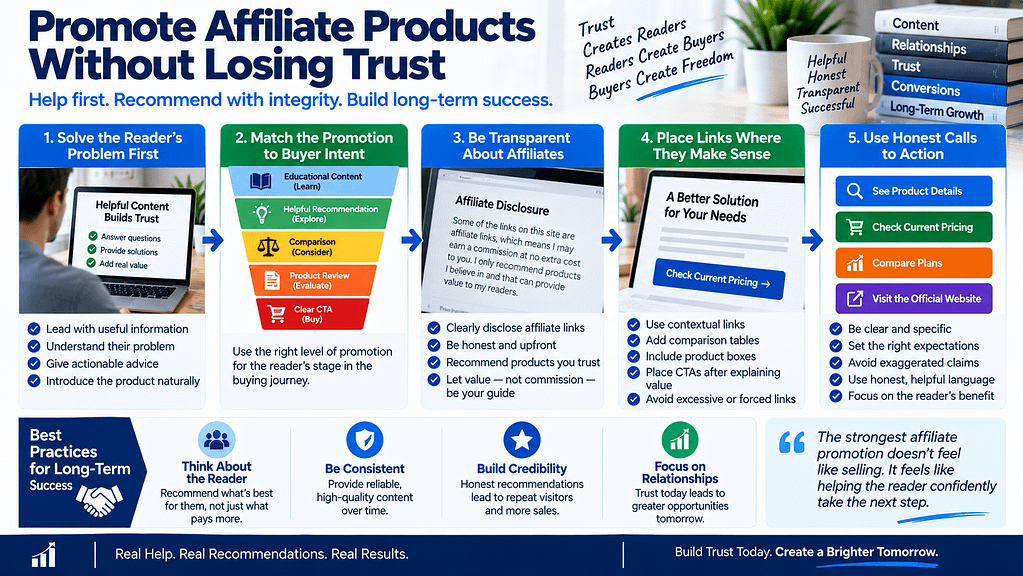
Use Honest Calls to Action
Your CTA should tell the visitor exactly what happens next. Examples include Check Current Pricing, See Product Details, Compare Plans, or Visit the Official Website.
Avoid exaggerated claims or artificial urgency that you cannot support.
Best Practice: Recommend the product you would choose for that particular reader—even when another product pays a higher commission.
Key Takeaway
The strongest affiliate promotion doesn’t feel like selling. It feels like helping the reader confidently take the next step.
Chapter 8: Build Your Affiliate Product Evaluation & Promotion Plan
This final chapter should turn everything from the guide into a repeatable system for choosing which affiliate products are actually worth promoting.
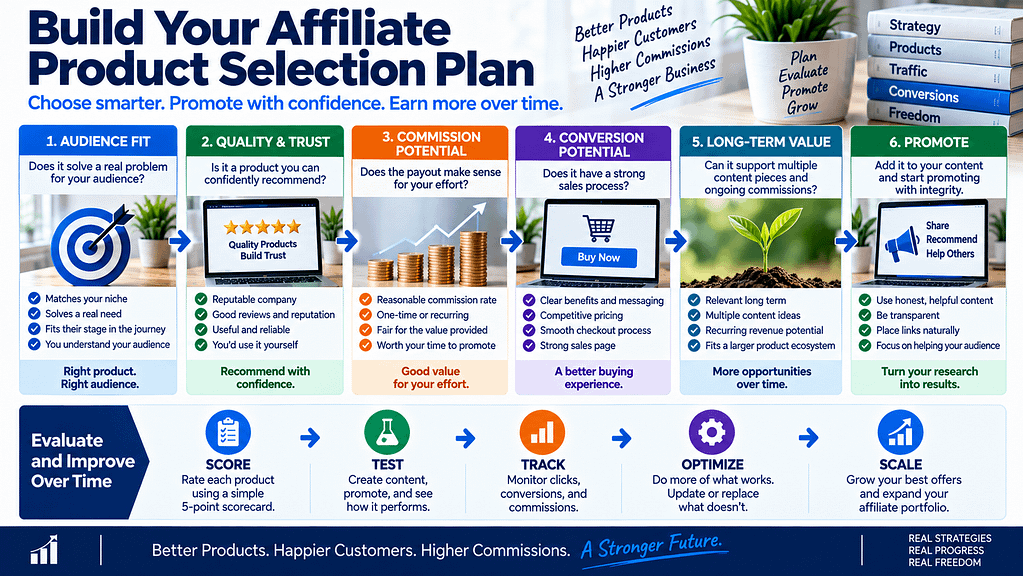
Create Your Product Selection Scorecard
Before adding a product to your site, evaluate it across five areas:
Audience Fit — Does it solve a real problem your audience already has?
Product Quality & Trust — Is the product credible, useful, and something you would feel comfortable recommending?
Commission Potential — Does the payout structure make sense for the effort required to promote it?
Conversion Potential — Does the offer have a strong sales page, reasonable pricing, clear benefits, and a smooth buying experience?
Long-Term Potential — Can this product support multiple pieces of content and generate commissions over time?
Use a Simple 5-Point Rating
Score each potential product from 1–5 in each category. A product that scores well across all five areas is usually a stronger opportunity than one chosen simply because it pays the highest commission.
Build a Balanced Affiliate Portfolio
Your goal isn’t to promote dozens of unrelated products. Build a smaller portfolio of strong offers that serve different needs within your niche. You might combine a core product, a lower-cost beginner option, a premium solution, and one or two complementary tools or services.
Review Your Results
Once you begin promoting an offer, track what actually happens:
Traffic → Affiliate Clicks → Conversions → Commissions
Products that perform well deserve more content and visibility. Products that receive qualified traffic and clicks but rarely convert should be reevaluated or replaced.
Key Takeaway: Choose affiliate products based on the complete opportunity—not simply the commission rate. The strongest offers combine audience fit, product quality, trust, conversion potential, and sustainable earning potential.
Related Guides
- Create Affiliate Content That Ranks, Helps & Converts
- Turn Affiliate Traffic Into Conversions & Commissions
- Track & Measure Affiliate Marketing Performance
For a practical research packet, shortlist, and commission-math workflow, use the AI-assisted affiliate product research guide. When an offer becomes a review, follow the trustworthy AI-assisted review template.