
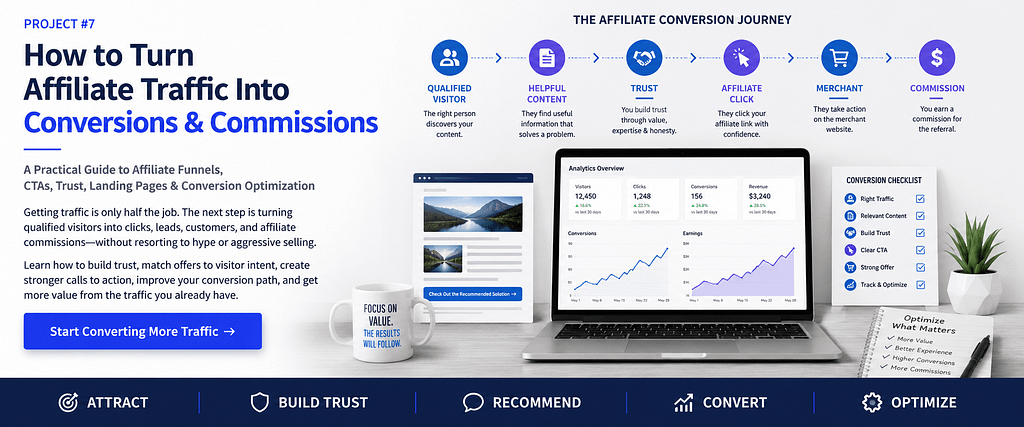
A Practical Guide to Affiliate Funnels, CTAs, Trust, Landing Pages & Conversion Optimization
Getting traffic is only half the job. The next step is turning qualified visitors into clicks, leads, customers, and affiliate commissions—without resorting to hype or aggressive selling.
Learn how to build trust, match offers to visitor intent, create stronger calls to action, improve your conversion path, and get more value from the traffic you already have.
What You’ll Learn in This Guide
By the end of this guide, you’ll understand how to turn more of your existing traffic into meaningful actions and affiliate commissions. Instead of simply adding more links or buttons, you’ll learn how to improve the entire journey from a visitor’s first interaction with your content to the moment they make a buying decision.
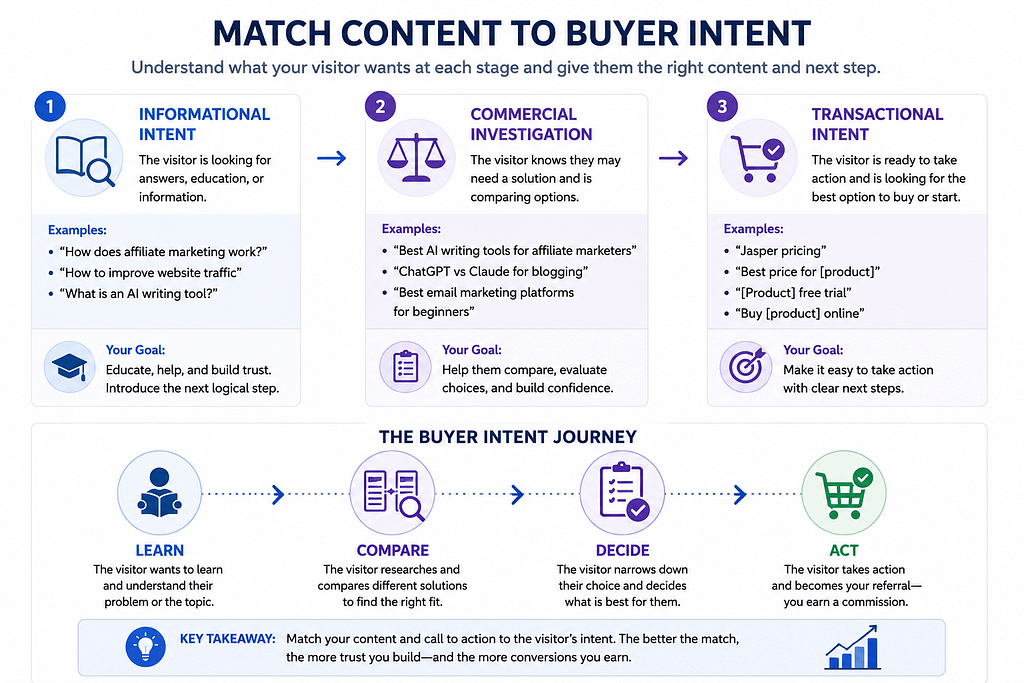
Understand Buyer Intent
Learn why visitors arrive with different levels of purchase intent and how to match your content to where they are in the buying journey.
Create Stronger Calls to Action
Learn where to place affiliate links and CTAs, what makes people click, and how to guide readers without becoming overly promotional.
Create a Simple Conversion Funnel
Connect traffic, content, email, affiliate recommendations, and follow-up into a clear path that moves visitors toward action.
Build Trust Before the Click
Use transparency, useful advice, balanced recommendations, and genuine expertise to make visitors comfortable acting on your recommendations.
Build Better Conversion Content
Understand how reviews, comparisons, tutorials, “best” lists, alternatives, and supporting articles serve different roles in the conversion process.
Measure & Improve Results
Track the numbers that matter, identify weak points in your conversion path, and improve existing content before simply chasing more traffic.
DIFFICULTY
Beginner–Intermediate
ESTIMATED TIME
45–60 Minutes
BEST FOR
Affiliate Marketers Ready to Improve Conversions
WHAT YOU’LL CREATE
Your Affiliate Conversion Optimization Plan
- What You'll Learn in This Guide
- Chapter 1: Understand the Affiliate Conversion Journey
- Chapter 2: Match Content to Buyer Intent
- Chapter 3: Build Trust Before Asking for the Click
- Chapter 4: Create Affiliate Calls to Action That Get Clicked
- Chapter 5: Build High-Converting Affiliate Content
- Chapter 6: Create a Simple Affiliate Conversion Funnel
- Chapter 7: Measure & Improve Your Conversion Rate
- Chapter 8: Build Your Affiliate Conversion Optimization Plan
- Final Thoughts: Turn More of Your Traffic Into Results
- Recommended Next Reads
- Ready to Improve Your Affiliate Conversions?
Chapter 1: Understand the Affiliate Conversion Journey
Getting a visitor to your website is an important win—but traffic by itself doesn’t create affiliate revenue. A visitor has to move through a series of steps before a commission can happen.
Think of this as the affiliate conversion journey:
Qualified Visitor → Helpful Content → Trust → Recommendation → Affiliate Click → Merchant → Commission
Qualified Visitor
The process begins with the right person. A visitor who has a problem your content addresses and an interest in the products or services you recommend is far more valuable than hundreds of random visitors.
Helpful Content
Before asking someone to click an affiliate link, give them something useful. Answer the question that brought them to your page, explain their options, and help them understand the decision they’re trying to make.
Trust
Visitors are more likely to consider your recommendations when they believe you’re trying to help them make a good decision—not simply earn a commission.
Trust grows through useful information, transparency, balanced pros and cons, clear disclosures, and recommendations that genuinely fit the reader’s needs.
Recommendation
Once you’ve helped the reader understand the problem and possible solutions, your affiliate recommendation becomes a natural next step.
Instead of:
“Buy this product now.”
Think:
“Based on what we’ve covered, this may be a good option if you need…”
That difference is important. We’re helping the visitor make a decision rather than trying to force one.
Affiliate Click
The affiliate link or CTA gives the visitor a clear path to learn more about the recommended solution.
The goal isn’t to put affiliate links everywhere. It’s to place the right link at the moment when the reader has enough information to want the next step.
Merchant & Commission
After the visitor clicks your affiliate link, they arrive at the merchant’s website. The merchant ultimately controls the checkout experience, pricing, product page, and final conversion.
If the visitor completes the required action and the referral is properly tracked, you earn the affiliate commission.
The Key Lesson
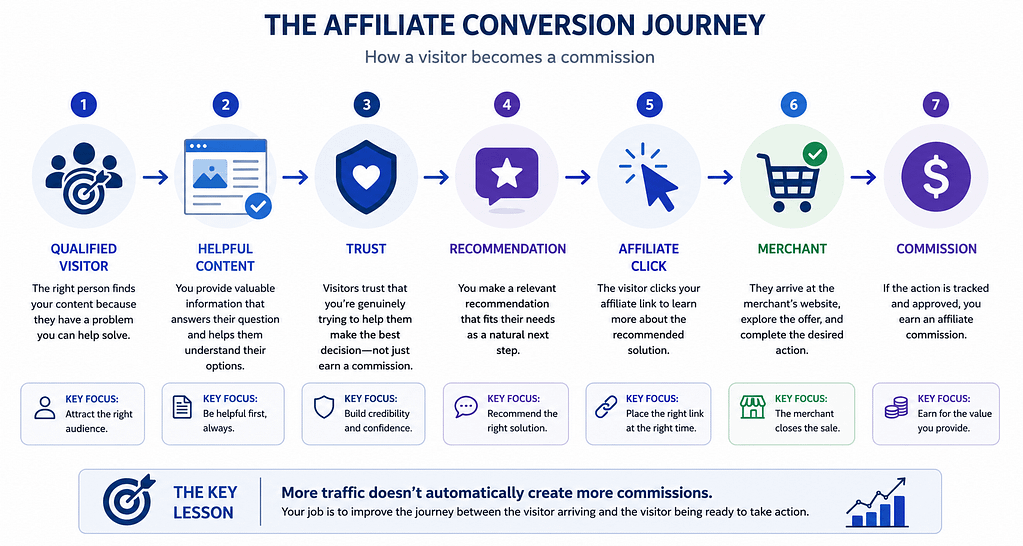
More traffic doesn’t automatically create more commissions.
Your job is to improve the journey between the visitor arriving and the visitor being ready to take action.
Chapter 2: Match Content to Buyer Intent
Getting a visitor to your website is an important win—but traffic by itself doesn’t create affiliate revenue. A visitor has to move through a series of steps before a commission can happen.
Think of this as the affiliate conversion journey:
Qualified Visitor → Helpful Content → Trust → Recommendation → Affiliate Click → Merchant → Commission
Qualified Visitor
The process begins with the right person. A visitor who has a problem your content addresses and an interest in the products or services you recommend is far more valuable than hundreds of random visitors.
Helpful Content
Before asking someone to click an affiliate link, give them something useful. Answer the question that brought them to your page, explain their options, and help them understand the decision they’re trying to make.
Trust
Visitors are more likely to consider your recommendations when they believe you’re trying to help them make a good decision—not simply earn a commission.
Trust grows through useful information, transparency, balanced pros and cons, clear disclosures, and recommendations that genuinely fit the reader’s needs.
Recommendation
Once you’ve helped the reader understand the problem and possible solutions, your affiliate recommendation becomes a natural next step.
Instead of:
“Buy this product now.”
Think:
“Based on what we’ve covered, this may be a good option if you need…”
That difference is important. We’re helping the visitor make a decision rather than trying to force one.
Affiliate Click
The affiliate link or CTA gives the visitor a clear path to learn more about the recommended solution.
The goal isn’t to put affiliate links everywhere. It’s to place the right link at the moment when the reader has enough information to want the next step.
Merchant & Commission
After the visitor clicks your affiliate link, they arrive at the merchant’s website. The merchant ultimately controls the checkout experience, pricing, product page, and final conversion.
If the visitor completes the required action and the referral is properly tracked, you earn the affiliate commission.
The Key Lesson
More traffic doesn’t automatically create more commissions.
Your job is to improve the journey between the visitor arriving and the visitor being ready to take action.
Understanding buyer intent starts with understanding what people search for and why. Our Keyword Research for Affiliate Marketing: The Complete 2026 Guide explains how to identify those opportunities before you create the content.
Chapter 3: Build Trust Before Asking for the Click
Affiliate marketing depends on trust. Visitors know they have countless websites, reviews, videos, and recommendations to choose from. If your content feels like it exists only to push an affiliate link, many readers will leave before they ever consider your recommendation.
The better approach is simple:
Help first. Recommend second.
Give the Reader a Complete Answer
Don’t withhold useful information just to force an affiliate click.
Answer the reader’s question, explain what matters, identify potential problems, and give them enough information to make a better decision.
The affiliate recommendation should support the content, not replace it.
Show Both Strengths and Weaknesses
No product is perfect for everyone.
Instead of presenting every affiliate product as “the best,” explain:
- What the product does well
- Where it falls short
- Who it’s best for
- Who should probably choose something else
A balanced recommendation is more believable—and more useful—than nonstop praise.
Explain Why You’re Recommending It
Don’t simply write:
“We recommend Product X.”
Explain the reasoning:
Product X may be the better choice for beginners because it offers a simpler interface and requires less setup, while more experienced users may prefer Product Y for its advanced features.
Now you’re helping the reader choose, not just telling them what to buy.
Be Transparent About Affiliate Relationships
Readers should understand when you may earn a commission from a recommendation.
Your affiliate disclosure should be clear and easy to find—not buried because you’re afraid someone will see it.
Transparency doesn’t weaken a recommendation. It helps establish that you’re being straightforward about the business relationship.
Use Experience and Evidence Where Possible
Trust becomes stronger when recommendations include something more useful than information anyone could copy from a product page.
Where appropriate, include things such as:
Screenshots, examples, testing observations, demonstrations, comparisons, original analysis, specific use cases, and lessons learned.
The goal is to answer the question:
“Why should I trust this recommendation?”
Don’t Pretend Every Product Is for Everyone
Sometimes the most trustworthy recommendation is:
“This probably isn’t the right choice for you if…”
That may seem counterintuitive, but helping the wrong customer avoid a product strengthens your credibility with the right customer.
Best Practice
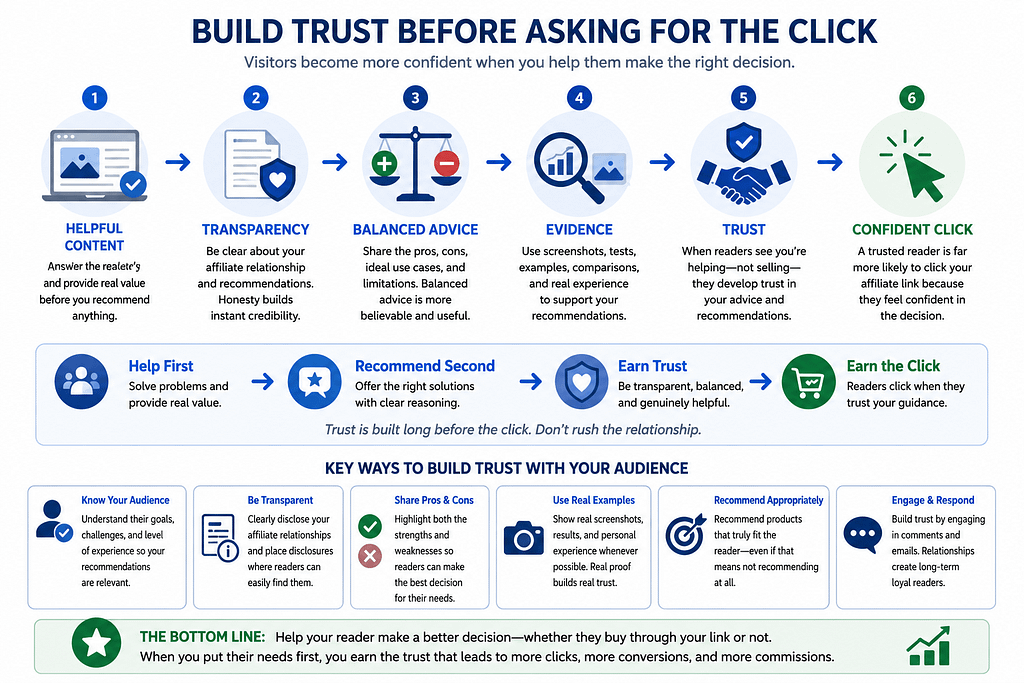
Trust is a conversion asset.
Don’t measure a page only by how many affiliate links it contains. Measure how effectively the page helps a reader become confident enough to make a decision.
Trust starts with content that genuinely helps the reader. See How to Create Affiliate Content That Ranks, Helps & Converts for our complete framework for building useful affiliate content around the reader’s needs.
Chapter 4: Create Affiliate Calls to Action That Get Clicked
A strong call to action doesn’t pressure someone into clicking. It makes the next step obvious at the moment the reader is ready to take it.
Your CTA should answer a simple question:
“What should I do next?”
Make the CTA Match the Content
The wording of your CTA should reflect what the visitor is trying to accomplish.
For example:
Educational content:
“Learn More About [Product]”
Product comparison:
“Compare Features & Pricing”
Product review:
“See [Product] in Action”
High-intent content:
“Check Current Pricing” or “Start Your Free Trial”
A generic “Click Here” gives the reader very little reason to act.
Place CTAs at Natural Decision Points
You don’t need an affiliate button after every paragraph.
Good CTA locations include:
- After explaining an important benefit
- After a comparison table
- After discussing pros and cons
- After explaining who the product is best for
- Near the conclusion after the reader has enough information to decide
Think decision points, not link density.
Use Contextual Links and Buttons
Both have a role.
Contextual affiliate links work naturally inside educational content when a product or service is relevant to the discussion.
CTA buttons are better when you want to make an important next step visually obvious.
A strong affiliate page will often use both without overwhelming the reader.
Tell the Reader What Happens Next
Reduce uncertainty by making your CTA specific.
Instead of:
Visit Site
Try:
View Features & Pricing →
Instead of:
Buy Now
Try:
Check Today’s Price →
Instead of:
Learn More
Try:
See How [Product] Works →
The reader should have a reasonable idea of what will happen after the click.
Don’t Create False Urgency
Avoid countdowns, fake scarcity, exaggerated claims, or “limited-time” language unless the merchant genuinely provides that offer and you can verify it.
Short-term pressure isn’t worth sacrificing long-term trust.
Test the Entire CTA Experience
A CTA isn’t successful simply because somebody clicks it.
Check:
CTA → Affiliate Link → Correct Merchant Page → Mobile Experience → Tracking
A broken or outdated affiliate link can waste highly qualified traffic.
Pro Tip
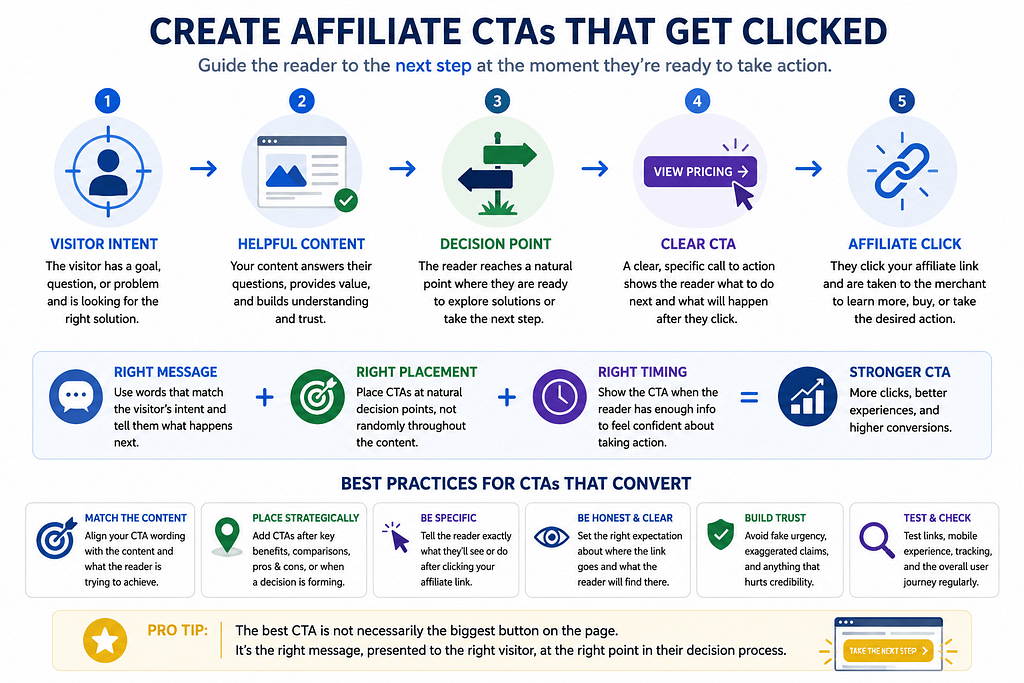
The best CTA is not necessarily the biggest button on the page.
It’s the right message, presented to the right visitor, at the right point in their decision process.
CTAs work best when they’re part of genuinely useful content rather than added as an afterthought. See How to Create Affiliate Content That Ranks, Helps & Converts for our complete affiliate content framework.
Chapter 5: Build High-Converting Affiliate Content
Not every piece of affiliate content should do the same job. Some pages attract people who are learning, while others help readers compare products, evaluate a specific solution, or make a final buying decision.
A strong affiliate website uses different content types for different stages of the buyer journey.
Product Reviews
A good review helps a reader decide whether a specific product is right for them.
Go beyond listing features. Cover:
What it does → Who it’s for → Key benefits → Limitations → Pricing → Alternatives → Final recommendation
The strongest reviews answer both:
“Why should I choose this?”
and
“Why might I choose something else?”
Product Comparisons
Comparison content is powerful because the reader is already evaluating options.
Examples:
Product A vs. Product B
ChatGPT vs. Claude
Platform X vs. Platform Y
Don’t simply declare a winner. Compare the products based on meaningful criteria and explain which type of user each option fits best.
“Best” and Roundup Content
Pages such as:
Best AI Writing Tools for Affiliate Marketers
can target readers who know they need a solution but haven’t decided which product to choose.
A useful roundup should explain why each product made the list and distinguish the options by use case.
For example:
Best for beginners
Best value
Best for advanced users
Best for automation
This makes the page genuinely useful instead of being a collection of affiliate links.
Tutorials and How-To Content
Tutorials often begin with informational intent but can create natural affiliate opportunities.
If you’re teaching someone how to accomplish a task and a particular tool helps them do it, recommending that tool becomes part of the solution.
The key is relevance:
Teach the process first. Introduce the product where it genuinely helps.
Alternatives Content
Someone searching for:
“Best alternatives to [Product]”
already knows about the product category and may be dissatisfied with an existing option.
Help the reader understand why they might choose each alternative, rather than simply presenting another list of products.
Supporting Educational Content
Don’t build a site containing nothing but reviews and “best product” pages.
Educational content brings people into your ecosystem earlier and gives your commercial content something valuable to connect with.
This creates a stronger content path:
Educational Guide → Tutorial → Comparison → Review → Affiliate Recommendation
Build Content Clusters
Instead of treating each article as an isolated page, connect related content.
For example:
Keyword Guide → AI Writing Guide → Best AI Writing Tools → Individual Tool Review
Now readers can move naturally from learning about a problem to evaluating possible solutions.
This also gives us exactly the type of internal-linking structure we’re building across ConsiderMakeMoneyOnline.com.
Best Practice
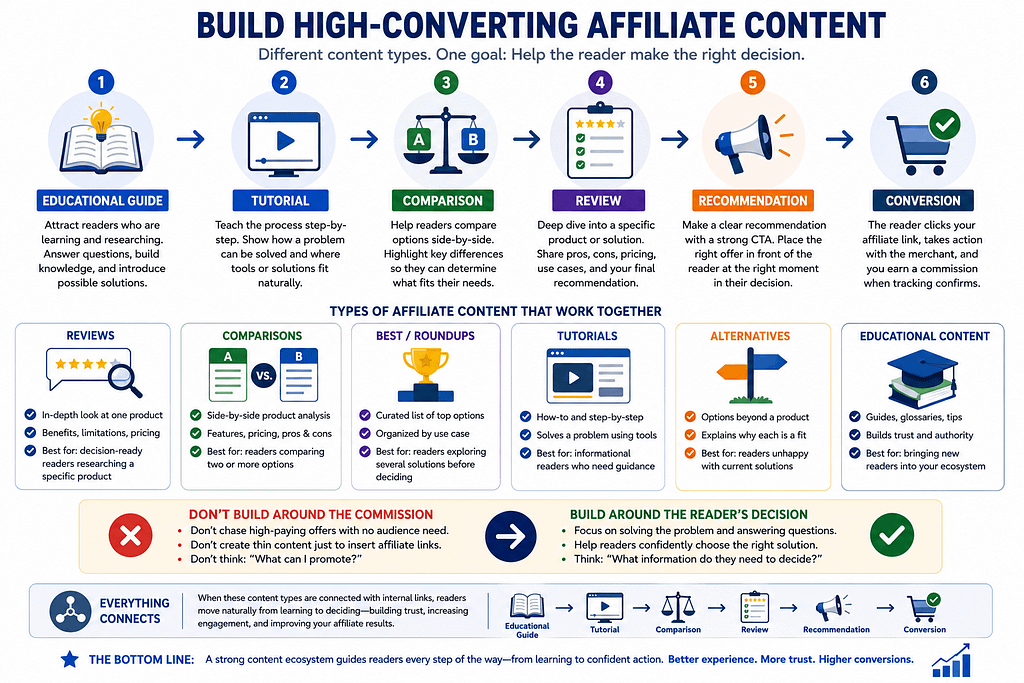
Don’t create affiliate content around the commission. Create it around the decision.
Ask what information the reader needs to confidently choose the right solution, and build the page around answering those questions.
For our complete framework for creating useful affiliate articles, reviews, comparisons, and supporting content, see How to Create Affiliate Content That Ranks, Helps & Converts.
ou can see this roundup approach in practice in 15 Best AI Writing Tools for Affiliate Marketers (2026), where different tools are organized around the needs of affiliate marketers.
Chapter 6: Create a Simple Affiliate Conversion Funnel
An affiliate funnel doesn’t need complicated software, dozens of pages, or an elaborate automation system.
At its simplest, a funnel is just the path a visitor follows from discovering you to taking a valuable action.
A practical affiliate funnel might look like this:
Traffic Source → Helpful Content → Trust → Affiliate Opportunity → Merchant → Conversion
Or, when you’re building an email audience:
Traffic Source → Helpful Content → Lead Magnet → Email Subscriber → Follow-Up → Affiliate Recommendation → Conversion
Step 1: Attract the Right Visitor
Your funnel begins before someone reaches your website.
SEO, YouTube, Pinterest, social media, email, and paid advertising can all generate traffic—but the visitor should arrive because your content matches a specific need or problem.
That’s why qualified traffic matters more than raw traffic volume.
Step 2: Deliver the Content They Expected
The page needs to fulfill the promise that brought the visitor there.
If someone searches for a product comparison, give them a useful comparison. If they click a tutorial, teach them how to accomplish the task.
Don’t make visitors hunt for the answer.
Step 3: Build Trust
Before asking for action, demonstrate that your goal is to help the visitor make a good decision.
Useful information, transparency, balanced recommendations, evidence, and clear explanations move the visitor closer to trusting your guidance.
Step 4: Present the Right Opportunity
Once the reader reaches a natural decision point, give them an appropriate next step.
That might be:
Read a comparison → View a product review → Download a checklist → Join your email list → Visit the merchant → Start a free trial
Not every visitor needs to go directly from article → affiliate link.
Step 5: Use Email to Extend the Journey
Email gives you another opportunity when a visitor isn’t ready to make a decision during the first visit.
A useful lead magnet can turn a one-time visitor into a subscriber.
From there, a welcome sequence can provide additional education, helpful resources, relevant recommendations, and reasons to return to your website.
Step 6: Send Qualified Visitors to the Merchant
Your job isn’t necessarily to close the entire sale.
Your job is to prepare the visitor so that when they reach the merchant, they understand:
What the product does → Why it may fit their needs → What to look for → What action to take next
The merchant then handles the final product page, signup, checkout, or purchase process.
Keep the Funnel Simple
Don’t add steps simply because marketers say you need a “funnel.”
Every additional step creates another opportunity for the visitor to leave.
Start with the shortest useful path and add complexity only when it improves the experience.
Best Practice
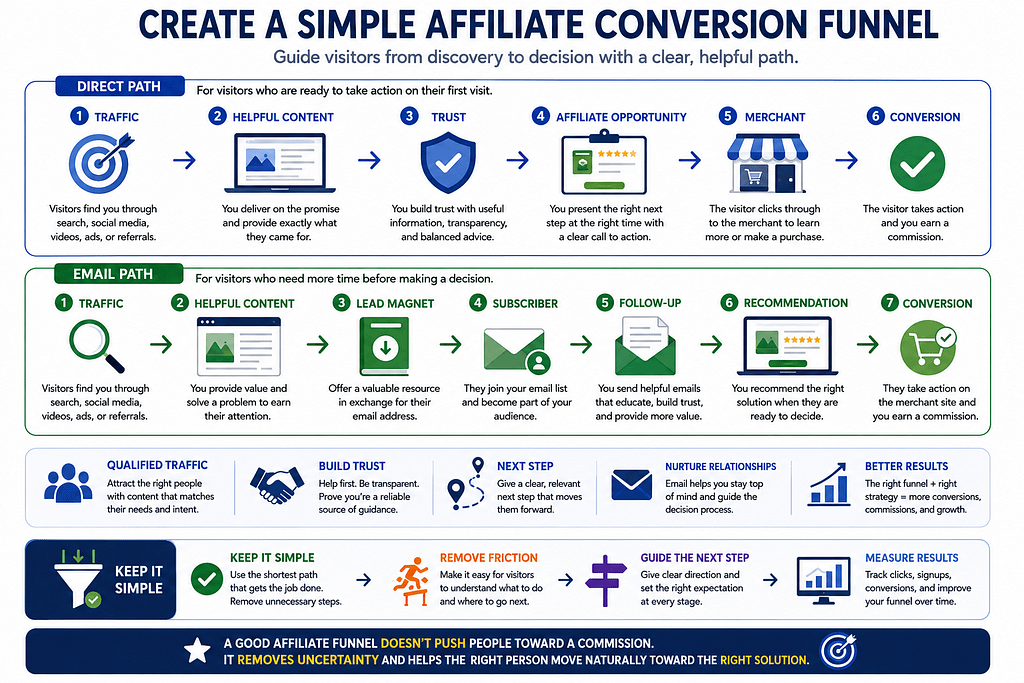
A good affiliate funnel doesn’t push people toward a commission.
It removes uncertainty and helps the right person move naturally toward the right solution.
A conversion funnel can’t work without qualified visitors entering it. See How to Drive Traffic to Your Affiliate Content for our complete system covering SEO, social media, YouTube, Pinterest, email, and paid traffic.
Chapter 7: Measure & Improve Your Conversion Rate
Once your affiliate funnel is working, the next step isn’t automatically getting more traffic. Sometimes the fastest way to increase affiliate revenue is to get better results from the traffic you already have.
Conversion optimization starts with measuring what visitors actually do.
Track the Numbers That Matter
You don’t need dozens of metrics. Start with a few that tell you whether visitors are moving through your conversion path.
Page Visitors
How many people reach the page?
Affiliate Clicks
How many visitors click one of your affiliate links?
Click-Through Rate (CTR)
What percentage of visitors click through to the merchant?
Conversions
How many referred visitors complete the action required for you to earn a commission?
Conversion Rate
What percentage of referred visitors convert?
Affiliate Revenue
How much revenue is the page, campaign, or traffic source actually producing?
Find Where Visitors Drop Off
Think of your conversion path as a series of checkpoints:
Visitors → Engagement → CTA → Affiliate Click → Merchant → Conversion
If a page gets plenty of traffic but very few affiliate clicks, the problem may be your content, offer relevance, CTA placement, or buyer intent.
If you’re getting plenty of affiliate clicks but very few conversions, investigate the merchant offer, pricing, landing page, audience fit, or traffic quality.
Finding the weak point tells you what to improve next.
Improve One Variable at a Time
Don’t redesign an entire page every time performance disappoints you.
Test meaningful changes such as:
- CTA wording
- CTA placement
- Product recommendation
- Comparison table
- Introduction
- Pros and cons
- Supporting evidence
- Internal links
- Page usability
When possible, change one major variable at a time so you can better understand what affected the result.
Start With High-Traffic Pages
A small conversion improvement on a page receiving substantial qualified traffic can produce more value than a large improvement on a page almost nobody visits.
Prioritize pages that already have:
Traffic + commercial intent + affiliate opportunities.
Those are often your best optimization candidates.
Don’t Optimize Only for Clicks
A higher affiliate CTR isn’t automatically better.
If aggressive CTA placement generates more clicks but sends poorly qualified visitors to the merchant, your actual conversion rate and earnings may not improve.
The goal is not:
Maximum clicks
The goal is:
More qualified clicks that produce valuable actions.
Build an Optimization Cycle
Use this process repeatedly:
Measure → Identify Weak Point → Make One Improvement → Measure Again → Keep or Adjust → Repeat
Over time, small improvements can compound across your highest-performing pages.
Marketing Fact
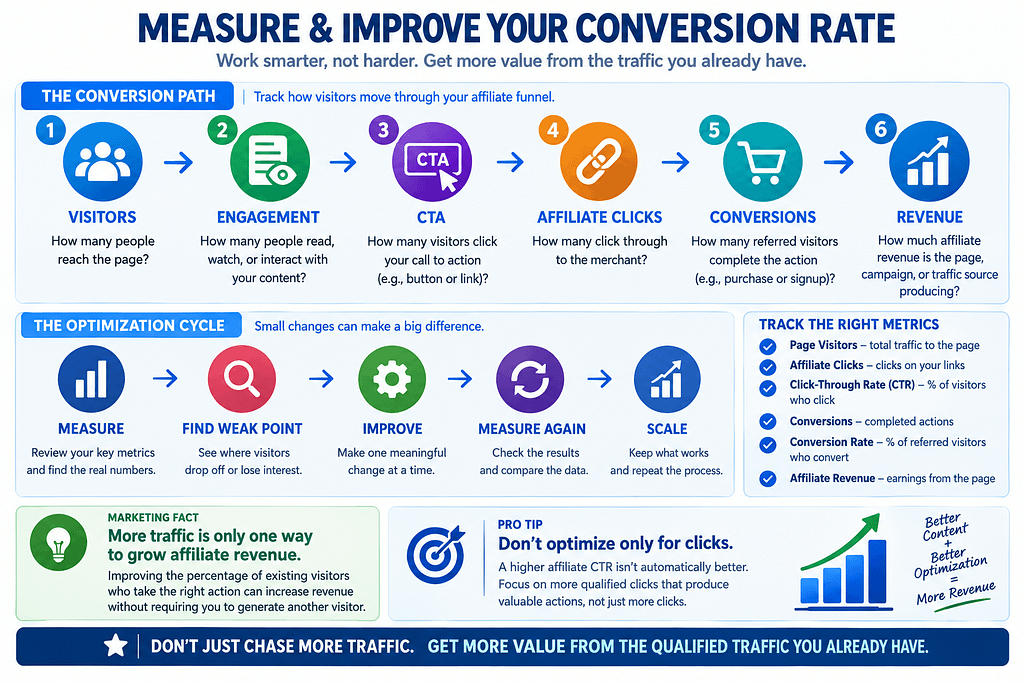
More traffic is only one way to grow affiliate revenue.
Improving the percentage of existing visitors who take the right action can increase revenue without requiring you to generate another visitor.
Before optimizing conversions, make sure you’re attracting the right audience in the first place. How to Drive Traffic to Your Affiliate Content explains how to build qualified traffic through SEO, social media, YouTube, Pinterest, email, and paid channels.
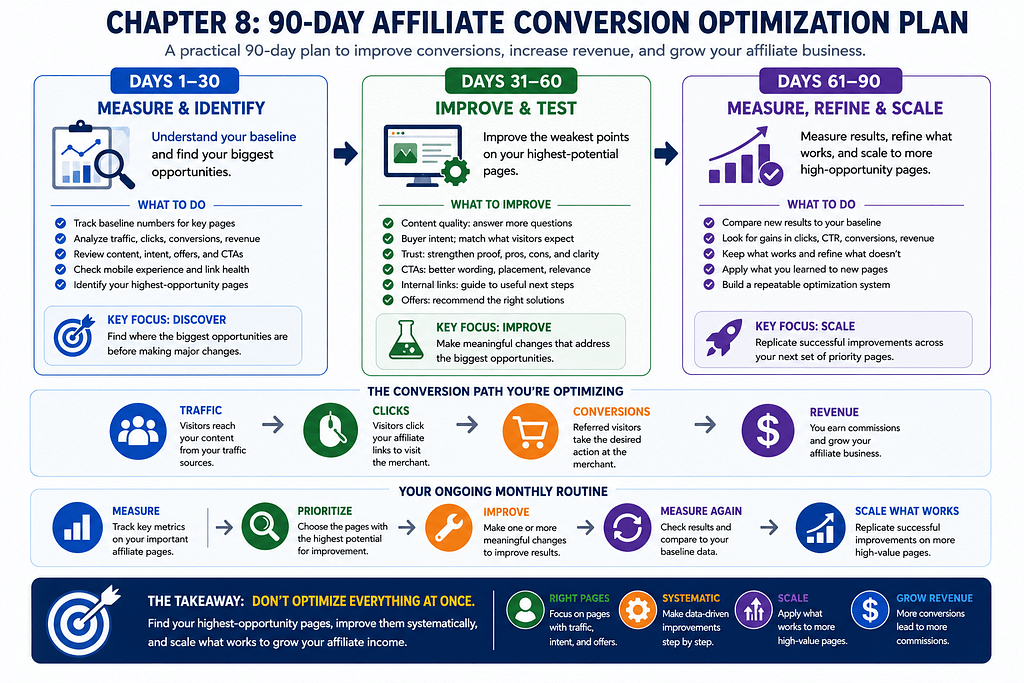
Chapter 8: Build Your Affiliate Conversion Optimization Plan
Stop Trying to Fix Everything at Once
Conversion optimization can quickly become overwhelming if you try to rewrite every article, change every CTA, test every offer, and rebuild your entire website at the same time.
Instead, focus on the pages that already have the greatest opportunity.
Start with pages that have:
Qualified Traffic + Buyer Intent + Affiliate Opportunity
Then improve those pages systematically.
Days 1–30: Measure & Find Opportunities
Your first month is about understanding what’s happening now.
Identify several important affiliate pages and record the baseline numbers you can reasonably track:
Traffic → Affiliate Clicks → CTR → Conversions → Revenue
Then review each page.
Ask:
Does the page match search intent?
Is the recommendation relevant?
Are the pros and cons balanced?
Are CTAs clear and easy to find?
Do affiliate links work?
Does the page look good on mobile?
Is there a logical next step?
Don’t start changing everything yet. First determine where the biggest opportunities are.
Days 31–60: Improve the Weakest Points
Now start improving the pages with the greatest potential.
Work on areas such as:
Content quality — answer unanswered questions and improve weak sections.
Buyer intent — make sure the page gives visitors what they actually came for.
Trust — strengthen explanations, disclosures, evidence, pros and cons.
CTAs — improve wording, placement, and relevance.
Internal links — guide readers toward useful comparisons, reviews, tutorials, and related resources.
Offers — make sure you’re recommending solutions that genuinely fit the audience.
Make meaningful changes, but avoid changing so many things simultaneously that you can’t learn from the results.
Days 61–90: Measure, Refine & Scale
Return to your numbers.
Compare the updated performance with your original baseline.
Look for improvements in:
Affiliate clicks
Click-through rate
Conversions
Revenue
Keep the changes that appear to help.
Refine the areas that still aren’t performing.
Then take what you’ve learned and apply it to the next group of high-opportunity pages.
That’s how optimization becomes a repeatable business system rather than a one-time project.
Your Ongoing Monthly Routine
After the first 90 days, establish a simple routine:
Measure → Prioritize → Improve → Measure Again → Scale What Works
You don’t need to optimize your entire website every month.
Choose a manageable number of important pages and continuously make them more useful.
Remember the Bigger System
Projects #5, #6, and #7 now fit together:
Create Helpful Content → Attract Qualified Traffic → Improve Conversions → Earn More From the Audience You’ve Built
Final Chapter Callout
Conversion optimization isn’t about manipulating visitors into clicking.
It’s about removing friction, answering questions, building confidence, and making the next step easier for the right visitor.
Strong conversions begin with strong content and qualified visitors. Use How to Create Affiliate Content That Ranks, Helps & Converts to strengthen your content foundation, then use How to Drive Traffic to Your Affiliate Content to build the qualified audience entering your conversion funnel.
Final Thoughts: Turn More of Your Traffic Into Results
Getting more affiliate traffic matters, but traffic becomes valuable only when visitors can move naturally from discovering your content to making a confident decision.
That doesn’t mean filling your pages with more affiliate links or pushing visitors harder. It means improving the entire experience: understanding buyer intent, creating useful content, building trust, making relevant recommendations, using clear calls to action, and removing unnecessary friction.
Remember the system:
Qualified Traffic → Helpful Content → Trust → Recommendation → Action → Conversion
Then measure what happens and improve the weakest points.
Small improvements across your best pages can compound over time. You don’t need to optimize everything at once. Focus on the pages with the greatest opportunity, learn from the results, and apply what works elsewhere.
Recommended Next Reads
Add another H2:
Recommended Next Reads
How to Create Affiliate Content That Ranks, Helps & Converts
Build useful content that attracts readers, earns trust, and creates natural affiliate opportunities.
How to Drive Traffic to Your Affiliate Content
Build qualified traffic through SEO, social media, YouTube, Pinterest, email, and paid channels.
Keyword Research for Affiliate Marketing: The Complete 2026 Guide
Find the searches, questions, and buyer-intent opportunities that can bring the right audience to your content.
Ready to Improve Your Affiliate Conversions?
You now have the complete framework. Choose your highest-opportunity affiliate pages, establish your baseline, and begin your 90-day conversion optimization plan.
If your next step includes a signup resource and follow-up emails, use the AI-assisted funnel guide to plan the path and test delivery. Keep the underlying recommendation traceable with the trustworthy review workflow.