

Keyword Research for Affiliate Marketing
The Complete 2026 Guide
Learn how to discover what your audience is searching for, understand why they’re searching, evaluate keyword opportunities, and turn those insights into a content strategy that attracts the right visitors to your affiliate website. If you are building your foundation, begin with our Start Here affiliate-marketing roadmap.
Best Keywords for Affiliate Marketing: What Should You Target?
The best keywords for affiliate marketing are searches that match what your audience wants while giving you a realistic opportunity to rank and earn commissions. Instead of simply chasing the highest search volume, look for keywords with clear intent, manageable competition, and a natural connection to products or services you can recommend.
For most affiliate marketers, the best opportunities fall into four groups: informational keywords that answer questions, commercial keywords that help people compare options, transactional keywords used by people close to making a purchase, and long-tail keywords that target specific problems or needs.
- “Best” keywords — best email marketing software for beginners
- Comparison keywords — ConvertKit vs Mailchimp
- Review keywords — [product name] review
- Problem-solving keywords — best tool for creating affiliate content
- Long-tail informational keywords — how to find low competition affiliate keywords
The right keyword mix depends on your niche, your site’s authority, and where the searcher is in the buying journey. In this guide, you’ll learn how to find, evaluate, organize, and prioritize those opportunities instead of relying on a generic list of keywords.
Worked example: turn a broad keyword into a useful page
There is no universal list of the best affiliate keywords. A useful choice depends on the audience, the decision, and the evidence you can contribute. Here is an editorial demonstration for a site serving tutorial creators who are choosing caption software. These phrases are research candidates; no search volume, difficulty score, or ranking result is claimed.
| Candidate query | Likely reader task to verify | Page you could justify | Evidence needed |
|---|---|---|---|
| best caption software | Compare a broad set of options | A roundup if you can evaluate a defined shortlist | Consistent criteria, current plan details, and supported recommendations |
| caption software with SRT export | Find a specific workflow feature | A focused comparison or export tutorial | Vendor export documentation and, ideally, a repeatable sample-clip test |
| how to fix inaccurate auto captions | Solve a practical problem | A correction tutorial | Screenshots of the process and a clear account of what you did |
| [tool A] vs [tool B] for tutorials | Choose between two products | A comparison for tutorial creators | The same input and criteria for both, with research limits stated |
Our editorial choice: Start with the specific export question if you can document that workflow. It has a defined decision and a testable answer. This choice reflects the evidence you can produce; it is not a finding that the query has low competition or sufficient search demand.
- Check the actual search results. Note which page types dominate and whether the results address the export requirement.
- Verify interest with a keyword tool, existing Search Console queries, or direct audience questions. Treat tool volumes as estimates.
- Record the gap: for example, current plan restrictions, supported file formats, or unclear export steps. Do not assume a gap exists until you inspect the pages.
- Decide whether one guide can cover related export questions. Create a separate page only when the reader needs a distinct answer.
- Write the main answer with verified conditions. If you have not tested a product, say the page is based on documentation.
Copy this keyword decision worksheet
| Field | What to record |
|---|---|
| Audience and task | Who is searching and the decision they need to make |
| Candidate query | The exact phrase and closely related questions |
| Demand evidence | Source, date, and what the evidence actually shows |
| Observed intent | Dominant page types and the task addressed in live results |
| Content gap | A specific unanswered question you can document |
| Evidence you can provide | Tests, screenshots, source links, or clearly labeled research |
| Suitable next step | A related guide, comparison, setup lesson, or relevant offer |
| Decision | Publish, combine with an existing guide, research further, or skip |
For prompts that generate candidates while keeping validation separate, follow our guide to finding low-competition affiliate keywords with AI. When the shortlist becomes a review, use the trustworthy affiliate review workflow to keep claims traceable.
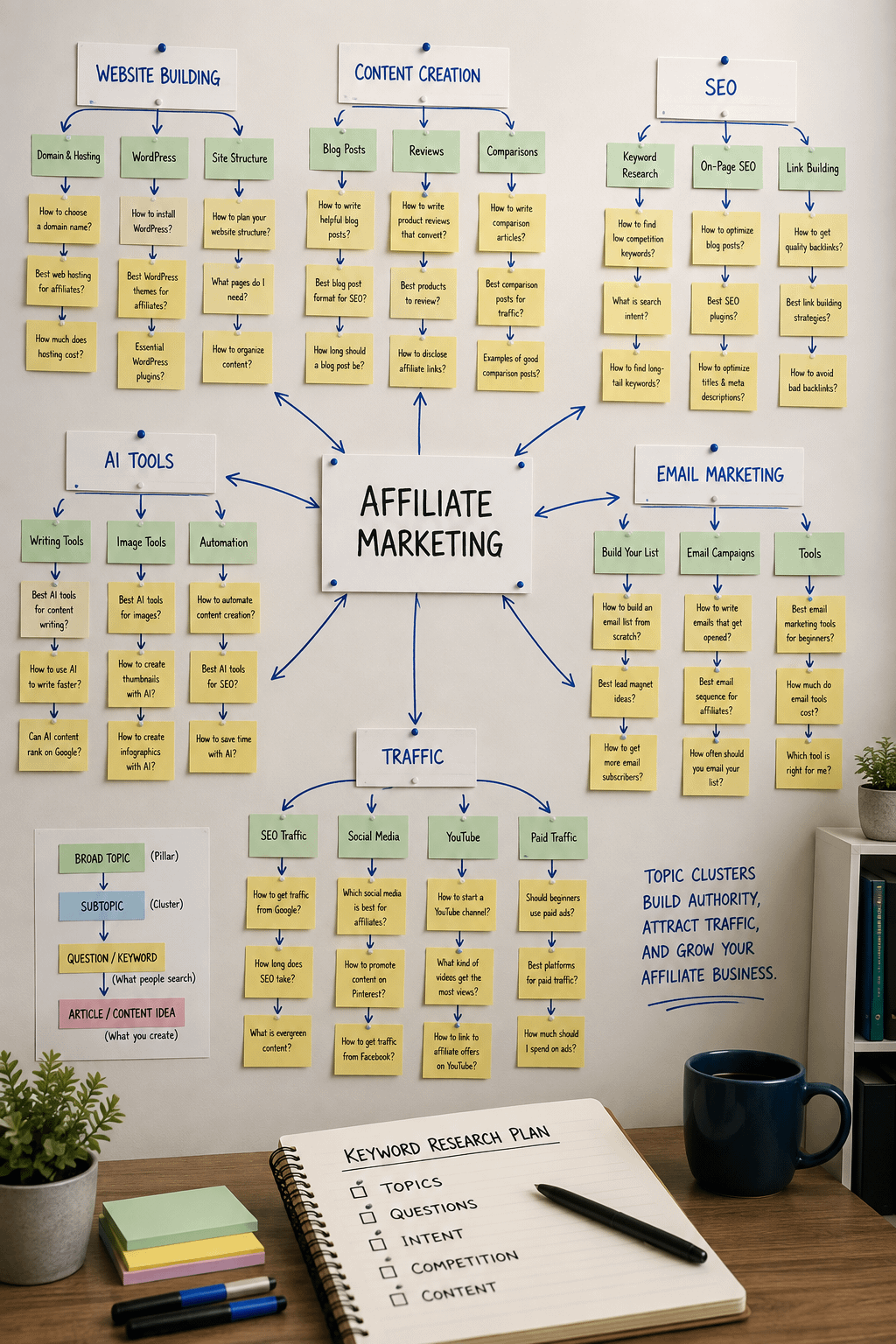
What You’ll Learn
By the end of this guide, you’ll know how to:
- Understand what keyword research actually tells you.
- Identify the intent behind a search.
- Turn broad niche ideas into specific topics.
- Find long-tail keywords and real audience questions.
- Evaluate search demand without relying blindly on volume numbers.
- Analyze competition realistically.
- Identify keywords with commercial and affiliate potential.
- Group related searches into topic clusters.
- Research questions that may surface in traditional search and AI answer experiences.
- Turn your research into an organized publishing plan.
Difficulty: ⭐⭐ Beginner–Intermediate
Reading Time: 50–55 minutes
Previous Lesson: How to Build an Affiliate Marketing Website
Next Lesson: How to Create Affiliate Content
Table Of Contents
- Best Keywords for Affiliate Marketing: What Should You Target?
- Worked example: turn a broad keyword into a useful page
- What You'll Learn
- Chapter 1: What Is Keyword Research and Why Does It Matter?
- Chapter 2: Understanding Search Intent
- Chapter 3: Finding Seed Keywords and Topics
- Chapter 4: Finding Long-Tail Keywords and Questions
- Chapter 5: Evaluating Search Demand
- Chapter 6: Analyzing Keyword Competition
- Chapter 7: Finding Commercial and Affiliate Keywords
- Chapter 8: Building Keyword Clusters and Topical Authority
Chapter 1: What Is Keyword Research and Why Does It Matter?
Keyword research is the process of discovering what people are searching for, what questions they are asking, and what they hope to accomplish when they search.
For affiliate marketers, that makes keyword research much more than finding popular phrases to put into an article.
It helps answer three critical questions:
- What does my audience want to know?
- Why are they searching for it?
- What content should I create to give them the best answer?
A good keyword strategy connects audience demand with your content strategy.
Keywords Are Really Clues About Your Audience
Suppose your website covers home coffee equipment.
Someone might search for:
best coffee grinder for beginners
Another person searches:
burr grinder vs blade grinder
And another asks:
why does my coffee taste bitter?
Those searches are different, but each gives us valuable information about the person behind the search.
The first person may be close to buying.
The second is comparing options.
The third is trying to solve a problem.
Keyword research helps us recognize those differences and create the right content for each visitor.
Think about the person behind the keyword—not just the keyword itself.
Keyword Research Has Changed
Years ago, SEO advice often focused heavily on finding a keyword, putting that exact phrase into an article several times, and trying to rank for it.
That approach is no longer enough.
Modern search systems are increasingly designed to understand topics, context, intent, relationships between concepts, and whether content actually answers the user’s question.
At the same time, people aren’t discovering information only through traditional search-result pages. They may encounter answers through AI-assisted search experiences and answer engines as well.
That means our goal isn’t to write an article around one phrase.
Our goal is to create the best resource for the underlying question or problem.
From Keyword to Complete Answer
Here’s the model I want readers to understand:
Keyword / Question
↓
Search Intent
↓
Problem or Goal
↓
Useful Answer
↓
Related Questions
↓
Complete Resource
The important idea is:
Don’t build content around words. Build content around what people need.
Why Keyword Research Matters for Affiliate Marketing
Affiliate websites depend on attracting people who are interested in the subjects, problems, and products the website covers.
Without keyword research, you’re largely guessing what to publish.
You might spend hours creating an excellent article about something very few people are searching for—or target a subject so competitive that a newer website has little realistic opportunity to gain visibility.
Keyword research helps reduce that guesswork.
It can help you:
- Discover topics people are actively interested in.
- Find questions your audience needs answered.
- Understand whether someone wants information, a comparison, or a product.
- Identify potential content gaps.
- Discover long-tail opportunities.
- Plan related articles instead of isolated posts.
- Prioritize content with potential commercial value.
- Build topical depth around your niche.
Keyword Research Supports the Hub-and-Spoke Model
This connects directly to what we taught in How to Build an Affiliate Marketing Website.
Instead of publishing unrelated articles, keyword research helps us discover groups of closely related questions.
For example:
Affiliate Marketing
↓
Keyword Research
↓
Search Intent — Long-Tail Keywords — Competition — Topic Clusters
↓
Individual Questions and Articles
The broad subject becomes the hub, while more focused guides and articles become the spokes.
That creates a logical learning path for readers while also making the relationships between your content clearer.
A Keyword Is the Beginning, Not the Content Strategy
One of the biggest mistakes beginners make is treating a spreadsheet of keywords as a content strategy.
It isn’t.
Imagine finding these searches:
affiliate marketing keywords
how to find affiliate keywords
keyword research for affiliates
best keywords for affiliate marketing
You shouldn’t automatically create four separate articles.
Those searches may represent substantially the same underlying topic and intent.
A stronger approach may be to create one comprehensive resource that answers the main question thoroughly and naturally addresses the related variations.
⚠️ Common Mistake
Creating a separate article for every slightly different keyword.
This can produce thin, repetitive pages that compete with one another rather than creating one strong resource.
Instead, organize closely related searches by topic and intent before deciding how many pages you actually need.
Think in Topics, Questions and Intent
As we move through this guide, use this simple framework:
TOPIC — What broad subject are we covering?
QUESTION — What specifically does the audience want to know?
INTENT — Why are they searching?
ANSWER — What would genuinely satisfy that need?
NEXT QUESTION — What are they likely to need after that?
That last one is particularly valuable.
It helps us build content that doesn’t merely answer one query—it helps readers continue their journey through the website.
And that gives us natural opportunities for internal linking.
✅ Action Step
Before using any keyword research tool, write down five questions you believe someone in your niche might search for.
Don’t worry about search volume yet.
For each question, ask:
What is this person actually trying to accomplish?
That’s the habit we’re going to develop throughout this guide.
Chapter 1 Takeaway
Keyword research isn’t simply about finding words with search volume.
It’s about understanding your audience through the language they use when they search.
When you understand the topic, question, intent, and desired outcome, you can create content that is more useful to readers and better organized for search and answer-driven discovery.
Chapter 2: Understanding Search Intent
Finding a keyword tells you what someone searched for.
Understanding search intent tells you why they searched for it.
That distinction is extremely important for affiliate marketers.
If someone searches:
what is affiliate marketing
they probably aren’t looking for the same thing as someone searching:
best affiliate marketing tools for beginners
And neither search has the same intent as:
Jasper vs ChatGPT for affiliate marketing
All three visitors are interested in affiliate marketing, but they’re at very different stages of the decision-making process.
The best keyword isn’t necessarily the one with the most searches. It’s the one whose intent matches the content you can genuinely help the reader with.
What Is Search Intent?
Search intent is the goal behind a person’s search.
In other words:
What does this person want to accomplish?
They might want to:
- Learn something.
- Find a particular website or resource.
- Solve a problem.
- Compare several options.
- Research a product before buying.
- Complete an action or purchase.
Understanding that goal helps you determine what type of page you should create.
The Five Search Intents We’ll Use
For our affiliate marketing strategy, we’ll organize searches into five practical categories.
1. Informational Intent
The searcher wants to learn something or solve a problem.
Examples:
what is affiliate marketing
how does keyword research work
how to start a blog
why isn’t my website getting traffic
The best content might be:
- Tutorials
- How-to guides
- Explanations
- Beginner guides
- Checklists
- Troubleshooting articles
Informational searches are especially valuable for building trust and bringing people into your content ecosystem.
Example
Keyword: how to choose an affiliate niche
Intent: Learn how to select a niche.
Best page: An in-depth educational guide.
That’s exactly the type of search our How to Choose a Profitable Affiliate Marketing Niche guide is designed to serve.
2. Navigational Intent
The searcher already knows where they want to go.
Examples might include searches for:
a specific company login
a particular website
a specific tool’s pricing page
These searches are usually less important when planning an affiliate site’s educational content because the searcher is often trying to reach a particular destination rather than discover a new resource.
That doesn’t make navigational searches useless. It simply means they usually aren’t our first priority when building our content plan.
3. Commercial Investigation Intent
Now we’re getting into particularly valuable territory for affiliate marketing.
The searcher is researching options before making a decision.
Examples:
best AI writing tools for affiliate marketers
best email marketing software for bloggers
best keyword research tools for beginners
best web hosting for affiliate marketing
This person may not be ready to buy immediately, but they’re actively evaluating possible solutions.
Good content formats include:
- Best-of lists
- Buying guides
- Product roundups
- Tool recommendations
- Alternatives articles
- Detailed reviews
Example
Keyword: best AI tools for affiliate marketers
Intent: Discover and evaluate AI tools.
Best page: A carefully researched tool roundup.
See how this search intent works in practice in our Best AI Tools for Affiliate Marketers 2026 roundup.
4. Comparison Intent
Comparison searches are a more specific form of commercial research.
The reader has often narrowed the choices and wants help deciding between them.
Examples:
Tool A vs Tool B
shared hosting vs managed hosting
free keyword research tools vs paid tools
AI writing tool vs traditional writing software
The content should help the reader understand:
What’s different?
What are the advantages?
What are the disadvantages?
Who is each option best for?
Which should I choose for my situation?
This is where affiliate marketers need to be particularly careful.
The objective isn’t to force the reader toward whichever product pays the highest commission.
The objective is to make the comparison genuinely useful.
A trustworthy comparison helps the reader choose—even when the best choice isn’t the product you would prefer them to buy.
That principle will matter when we build our product-review and comparison content later.
5. Transactional Intent
Transactional searches indicate that someone may be ready to take an action.
Examples:
buy [product]
[product] pricing
[product] free trial
sign up for [service]
[product] discount
The visitor is much farther along in the decision process.
For affiliate marketers, transactional searches can have strong commercial value—but they can also be highly competitive.
The appropriate destination might be:
- Product pages
- Offer pages
- Pricing information
- Reviews
- Deal pages
- Relevant merchant pages
We should never disguise an affiliate link as something else. The reader should understand where a recommendation or button is taking them.
Search Intent and the Reader Journey
Here’s the bigger picture.
A person might move through several intents before making a decision:
INFORMATIONAL
What is keyword research?
↓
COMMERCIAL
What are the best keyword research tools?
↓
COMPARISON
Tool A vs Tool B
↓
TRANSACTIONAL
Tool A pricing
This is important because an affiliate website shouldn’t consist entirely of articles targeting people who are ready to buy.
We want to help people through the entire decision journey.
Intent Should Determine the Page
| Search | Intent | Best Content |
|---|---|---|
| What is keyword research? | Informational | Educational guide |
| How do I find keywords? | Informational | Tutorial |
| Best keyword research tools | Commercial | Roundup |
| Tool A vs Tool B | Comparison | Comparison |
| Tool A pricing | Transactional | Pricing/review resource |
This table reinforces an important principle:
Choose the page format after you understand the intent—not before.
Why Intent Matters for Google and Answer Engines
Intent also matters beyond traditional keyword rankings.
Whether information is being surfaced through conventional search results or an AI-powered answer experience, clear content structure helps make the purpose of a page easier to understand.
That’s why we’re deliberately building our guides around:
Clear questions → direct answers → supporting explanation → useful examples → related next steps
We’re not writing for machines at the expense of readers.
We’re making the content easy for people to understand and easy for systems to interpret.
⚠️ Common Mistake: Targeting the Wrong Intent
Suppose someone searches:
best keyword research tools
But the page they reach spends 2,000 words explaining:
What is keyword research?
Even if the article is well written, it doesn’t adequately match what the reader wanted.
They already asked for tools.
The better page should quickly identify and compare useful options.
This is why keyword research without intent analysis can lead to content that targets the right words but gives the wrong answer.
Search Intent Can Change
One more important point: don’t assume every keyword permanently belongs to one category.
Language can be ambiguous, and search behavior changes.
When we’re evaluating important keywords later, we’ll look at the actual results being surfaced for that query and ask:
What kinds of pages are being rewarded?
Guides?
Reviews?
Product pages?
Videos?
Forums?
Direct answers?
Comparisons?
That gives us additional evidence about what people likely expect when they make that search.
✅ Action Step
Take the five questions you wrote down at the end of Chapter 1.
Next to each one, label its likely intent:
I = Informational
N = Navigational
C = Commercial
CP = Comparison
T = Transactional
Then ask:
What type of page would best satisfy this search?
Don’t think about affiliate commissions yet.
Think about what the searcher needs.
Chapter 2 Takeaway
Search intent tells us why someone is searching, and that should influence what we create.
For an affiliate website, the strongest content strategy usually includes a healthy mix of informational, commercial, comparison, and appropriately transactional content rather than concentrating exclusively on buyer keywords.
First understand the person and their goal.
Then choose the keyword.
Then create the page.
Chapter 3: Finding Seed Keywords and Topics
Now that you understand search intent, it’s time to start building your keyword universe.
The first step isn’t finding thousands of keywords.
It’s identifying a small number of seed keywords and core topics that represent the major subjects your audience cares about.
Seed keywords are starting points that help you discover the larger topics, questions, problems, and searches within your niche.
Think of them as the roots from which the rest of your keyword research grows.
What Is a Seed Keyword?
A seed keyword is a broad word or phrase that describes an important subject within your niche.
Suppose your website is about home coffee.
Possible seed keywords might include:
coffee makers
espresso machines
coffee grinders
coffee beans
cold brew
coffee brewing
These aren’t necessarily the keywords you’ll target with individual articles.
Instead, they’re starting points for discovering more specific searches.
For example:
Coffee Grinders
↓
best coffee grinders
↓
best burr grinder for beginners
↓
best burr grinder under $100
↓
manual vs electric coffee grinder
↓
how often should I clean a coffee grinder?
One broad topic has already revealed several potential content opportunities.
Start With the Problems Your Audience Has
Don’t begin by staring at a keyword tool waiting for it to tell you what your business is about.
Start with your audience.
Ask:
What are they trying to accomplish?
What problems are they experiencing?
What decisions do they need to make?
What products might help them?
What do beginners need to learn first?
What questions appear after they’ve learned the basics?
This approach can reveal topics that aren’t immediately obvious from a simple keyword list.
Keyword tools provide data. Your understanding of the audience gives that data meaning.
Use the Audience Journey to Find Topics
Think about someone progressing through your niche.
For affiliate marketing, that journey might look like:
Learn Affiliate Marketing
↓
Choose a Niche
↓
Build a Website
↓
Research Keywords
↓
Create Content
↓
Generate Traffic
↓
Join Affiliate Programs
↓
Optimize & Grow
Those major stages can become seed topics.
Notice something important?
That’s very similar to the learning path we’re building throughout this website.
Our curriculum itself gives us clues about the topics our audience needs.
Use the Alphabet Expansion Method
Once you have a seed phrase, expand it naturally.
Suppose the seed is:
affiliate marketing
Now ask what related concepts might exist:
affiliate marketing + beginners
affiliate marketing + website
affiliate marketing + content
affiliate marketing + SEO
affiliate marketing + AI
affiliate marketing + programs
affiliate marketing + traffic
Then go deeper:
affiliate marketing for beginners without an audience
affiliate marketing content ideas for beginners
affiliate marketing SEO strategy
AI tools for affiliate marketing content
We’re moving from:
Broad → Specific → More Specific
This is how a seed begins turning into actual content opportunities.
Look Where Your Audience Already Asks Questions
Keyword ideas don’t come only from SEO software.
Your audience is constantly telling you what it wants to know.
Look at places where people ask questions and discuss problems:
- Search suggestions
- Related searches
- Forums
- Reddit discussions
- YouTube comments
- Product reviews
- Online communities
- Social media
- Industry publications
- Competitor websites
- Customer support questions
You’re looking for recurring language.
If many people repeatedly ask variations of the same question, that’s worth investigating.
Competitors Can Reveal Topic Categories
Competitor research can also help identify subjects you may have overlooked.
Look at established sites in your niche.
Don’t copy their articles.
Instead, study their content architecture.
Ask:
What major categories do they cover?
Which topics appear repeatedly?
What questions do they answer?
Where are the gaps?
What subjects are outdated or poorly explained?
Three competitors might all cover:
Website Building
but perhaps none provides a comprehensive guide specifically for someone building their first affiliate website.
That’s potentially an opportunity.
Don’t Confuse Topics With Keywords
This distinction is important.
Topic
Keyword Research
Possible keywords/questions
what is keyword research
how to do keyword research
keyword research for beginners
how to find long-tail keywords
how to analyze keyword competition
how to find commercial keywords
The topic is the larger subject.
The keywords are different ways people express needs within that subject.
This is why we’re not going to build the website around a giant flat spreadsheet containing thousands of unrelated phrases.
We’re going to organize keywords underneath topics.
Build Your First Topic Map
Start with the niche in the center.
For example:
AFFILIATE MARKETING
Then branch outward:
Getting Started
Website Building
Keyword Research
Content Creation
SEO
Traffic
Affiliate Programs
AI & Tools
Then each topic branches again.
For example:
KEYWORD RESEARCH
↓
Search Intent
Seed Keywords
Long-Tail Keywords
Search Demand
Competition
Commercial Keywords
Topic Clusters
Recognize those?
They’re essentially the chapters we’re building in this guide.
That’s intentional.
We’re demonstrating the same strategy we’re teaching.
From Seed Keyword to Content Cluster
Here’s the progression I want readers to understand:
NICHE
↓
CORE TOPIC
↓
SEED KEYWORD
↓
RELATED QUESTIONS
↓
SEARCH INTENT
↓
CONTENT CLUSTER
↓
INDIVIDUAL PAGES
And it connects directly to our hub-and-spoke strategy.
🤖 Can AI Help Generate Seed Keywords?
Yes—but use it correctly.
AI can be useful for brainstorming:
- Topic categories
- Audience problems
- Related concepts
- Beginner questions
- Product categories
- Possible comparisons
- Alternative terminology
For example, you might ask an AI system:
“Give me 30 questions a beginner might ask before purchasing an espresso machine.”
That can quickly reveal possible directions for further research.
But there’s an important limitation:
An AI-generated keyword idea is an idea—not proof of search demand.
Don’t assume a phrase has meaningful search volume, low competition, or commercial value simply because an AI system suggested it.
Use AI for discovery and brainstorming.
Then validate promising ideas using additional research and data.
💡 Pro Tip: Use More Than One Source
Don’t let a single keyword tool determine your entire content strategy.
Combine information from:
Your audience knowledge + Search results + Competitors + Communities + Keyword tools + AI brainstorming
Different sources reveal different opportunities.
When several sources point toward the same questions or problems, pay attention.
⚠️ Common Mistake: Collecting Too Many Keywords
It’s easy to become addicted to keyword collection.
You begin with 20.
Then 200.
Then 2,000.
Then 20,000.
But you still haven’t published anything.
A giant keyword spreadsheet isn’t an affiliate business.
The purpose of keyword research is to help you make better publishing decisions.
Collect enough information to make a decision—then create the content.
✅ Action Step: Build Your Seed List
Take your niche and identify 5–10 major topics.
Under each topic, write 5 seed keywords or questions.
For example:
TOPIC: Website Building
- affiliate website
- domain name
- WordPress
- web hosting
- website structure
Then begin expanding each one.
You should finish this exercise with roughly 25–50 starting ideas.
Don’t worry about eliminating keywords yet.
We’re still in the discovery stage.
In the next chapters, we’ll determine which opportunities deserve attention.
Chapter 3 Takeaway
Seed keywords give your research direction.
Instead of asking:
“What keywords should I rank for?”
start with:
“What subjects, problems, questions, and decisions matter to the audience I’m trying to help?”
Then use seed keywords to explore those areas systematically.
That’s how keyword research becomes a content strategy rather than a keyword collection exercise.
Chapter 4: Finding Long-Tail Keywords and Questions
Seed keywords give us broad areas to investigate. Now we need to dig deeper and discover the specific questions, problems, comparisons, and searches people use within those topics.
This is where long-tail keyword research becomes especially valuable.
Long-tail keywords help you move from broad subjects to specific audience needs—the kinds of needs that often make excellent individual articles.
For a growing affiliate website, these more focused searches can help us identify realistic content opportunities while building depth around our major topics.
What Is a Long-Tail Keyword?
A long-tail keyword is a relatively specific search query, often with lower individual search demand than a broad, highly popular term.
Despite the name, a long-tail keyword doesn’t have to contain a certain number of words.
Consider:
coffee grinder
versus:
best coffee grinder for French press
The second search tells us much more.
We know the person:
Wants a coffee grinder
↓
Uses French press
↓
Is probably evaluating options
That specificity helps us understand both the topic and the intent.
Why Long-Tail Keywords Matter
Broad keywords can be attractive because they may receive substantial search activity.
But broad searches can also be:
- Highly competitive
- Ambiguous
- Difficult to satisfy with one page
- Dominated by established websites
- Poor indicators of what the searcher actually wants
Long-tail searches often provide more context.
Compare:
hosting
What does that person want?
A definition?
A hosting company?
Website hosting?
Event hosting?
best WordPress hosting for a small affiliate website
Now we have a much clearer picture.
The searcher appears to be evaluating hosting specifically for a WordPress affiliate site.
That gives us a better opportunity to create content that directly addresses the need.
Specificity Reveals Intent
Remember Chapter 2.
As searches become more specific, their intent can become easier to understand.
For example:
coffee maker
↓
best coffee maker
↓
best coffee maker for small kitchen
↓
best compact coffee maker without pods
Each additional detail tells us something about the person’s requirements.
That’s why long-tail research isn’t simply about finding “easy keywords.”
It’s about discovering specific problems we can answer well.
Turn Seed Keywords Into Questions
Let’s use one of our seed topics:
Website Hosting
Start asking questions around it:
What is web hosting?
How much hosting does a beginner need?
What type of hosting is best for WordPress?
Do I need hosting for an affiliate website?
What’s the difference between shared and managed hosting?
Can I change hosting companies later?
How much should web hosting cost?
Now we’ve transformed one broad topic into several potential content opportunities.
This is exactly what we want.
Use Question Modifiers
A simple way to expand seed keywords is to combine them with common question patterns.
Try:
What
Why
How
When
Where
Which
Can
Should
Does
Is
For example, starting with:
affiliate marketing website
we might investigate:
What is an affiliate marketing website?
How do I build an affiliate marketing website?
Can I do affiliate marketing without a website?
Should I use WordPress for affiliate marketing?
How much does an affiliate website cost?
How many pages does an affiliate website need?
These are much closer to the language real people use when they need help.
Use Problem-Based Modifiers
Questions aren’t the only useful long-tail searches.
People frequently search because something isn’t working.
Look for language such as:
why
not working
problem
fix
improve
avoid
mistakes
too slow
not ranking
no traffic
For example:
why is my WordPress site slow
why isn’t my affiliate website getting traffic
affiliate marketing mistakes beginners make
how to fix broken affiliate links
Problem-based searches can make excellent educational content because the visitor has a specific issue that needs solving.
Use Audience Modifiers
People also identify themselves through searches.
For example:
for beginners
for bloggers
for small businesses
for photographers
for seniors
for students
for beginners with no audience
Starting with:
keyword research
could lead to:
keyword research for beginners
keyword research for bloggers
keyword research for affiliate marketers
The audience modifier tells you who the content needs to serve.
That’s extremely useful when deciding whether a keyword fits your website.
Use Situation and Constraint Modifiers
Searchers often tell you their constraints.
Look for phrases such as:
without
with
under
for small
for large
free
low cost
beginner
advanced
fast
easy
For example:
keyword research without paid tools
free keyword research for beginners
best website builder for a small affiliate site
email marketing tools for a small list
These details can reveal highly focused content opportunities.
Comparison Keywords
Another valuable long-tail pattern is comparison.
Look for:
vs
versus
alternative
alternatives
compared with
better than
For example:
ChatGPT vs Claude for affiliate marketing
shared hosting vs managed WordPress hosting
free vs paid keyword research tools
WordPress alternatives for affiliate websites
These searches often indicate that someone has already done some research and is narrowing down a decision.
That can make them particularly relevant for affiliate content—provided the comparison is genuinely useful and balanced.
Commercial Long-Tail Patterns
You’ll also encounter phrases such as:
best
top
review
reviews
pricing
discount
worth it
alternatives
for [specific use]
For example:
best AI writing tools for affiliate marketers
best keyword research tool for a new website
is [tool] worth it for bloggers
best email platform for a small affiliate site
These searches may have stronger commercial intent than general informational questions.
But don’t chase every keyword containing best.
We’ll evaluate commercial opportunities much more carefully in Chapter 7.
Where Can You Find Long-Tail Questions?
You don’t need to rely on one tool.
Potential sources include:
- Search suggestions
- Related searches
- People-also-ask style questions
- Forums and communities
- Reddit discussions
- YouTube comments
- Product reviews
- Competitor articles
- Customer questions
- Keyword research tools
- AI brainstorming
The objective is to find recurring questions and language, not simply collect thousands of phrases.
Pay Attention to the Exact Language People Use
This is an overlooked part of keyword research.
Suppose you describe something as:
website performance optimization
but your audience repeatedly asks:
why is my WordPress site so slow?
Those phrases describe related concepts, but one reflects the language of the expert and the other reflects the language of the person experiencing the problem.
Good content understands both.
Learn the terminology of your subject—but write in the language your audience understands.
This is useful for traditional search and for answer-oriented discovery because natural questions give us clear problems to answer.
One Long-Tail Keyword Doesn’t Always Need One Article
This is important enough to repeat.
Suppose you discover:
how to find long-tail keywords
how do I find long-tail keywords
ways to find long-tail keywords
finding long-tail keywords for SEO
These probably don’t require four separate pages.
They likely represent one core need:
How do I find long-tail keywords?
One strong article can address the subject comprehensively.
We’re organizing questions into topics, not manufacturing a new page for every wording variation.
Build a Question Cluster
Suppose our topic is:
WordPress Hosting
We might discover:
What is WordPress hosting?
Do I need special hosting for WordPress?
How much does WordPress hosting cost?
Shared vs managed WordPress hosting
What hosting features does a beginner need?
Can I change WordPress hosts later?
Instead of treating these as six random keywords, organize them into a question cluster.
Then decide:
Which belong on the main guide?
and:
Which deserve their own supporting articles?
This is where keyword research begins turning into site architecture.
🤖 Using AI to Expand Questions
AI can be extremely useful during this stage.
Give it a topic and ask it to brainstorm questions from different perspectives.
For example:
Topic: WordPress hosting
Ask for questions from:
A complete beginner
Someone comparing providers
Someone worried about price
Someone with a slow website
Someone whose site is growing
That can reveal angles you hadn’t considered.
But remember the rule from Chapter 3:
AI can generate possibilities. It doesn’t prove that people are searching for them.
Use AI to expand the research.
Don’t use it as your only source of keyword data.
💡 Pro Tip: Keep a Question Bank
Create a simple document or spreadsheet containing questions you discover.
Use columns such as:
Question | Topic | Intent | Source | Search Demand | Competition | Content Type | Status
You won’t have all those answers yet.
That’s okay.
We’re going to fill them in as we progress through the guide.
By the end, this becomes the beginning of your content planning system.
⚠️ Common Mistake: Assuming Low Volume Means Low Value
A highly specific question may not receive thousands of searches every month.
That doesn’t automatically make it worthless.
A small number of highly relevant visitors can sometimes be more useful than a large number of visitors with little connection to your site’s purpose.
Also, keyword tools provide estimates—not perfect measurements of every way people express a question.
That’s why we don’t make decisions based on one number alone.
Chapter 5 will deal with this directly.
✅ Action Step: Expand Your Seed Keywords
Return to the seed list you created in Chapter 3.
Choose five seed keywords.
For each one, generate at least:
3 questions
2 problem-based searches
2 audience-specific searches
2 comparison or commercial searches
That gives you roughly 45 potential long-tail ideas from only five seed topics.
Then group obvious variations together.
Don’t evaluate them yet.
For now, we’re building the pool of possibilities.
Chapter 4 Takeaway
Long-tail keyword research helps us move from:
Broad Topic → Specific Need → Search Intent → Potential Content
The more clearly we understand the need behind a search, the easier it becomes to create content that genuinely deserves to answer it.
But now we reach an important question:
Are people actually searching for these topics?
That’s what we investigate next.
Chapter 5: Evaluating Search Demand
You’ve built a list of seed keywords, expanded those ideas into long-tail searches, and identified questions your audience may be asking.
Now we need to determine whether those topics represent real opportunities.
This is where many people immediately look for one number:
Monthly Search Volume
Search volume can be useful—but it should never make the decision by itself.
Search demand is bigger than search volume. Our goal is to determine whether enough people have the problem, question, or interest to justify creating the content.
What Is Search Volume?
Search volume is an estimate of how frequently a particular keyword or query is searched during a given period, commonly expressed as average monthly searches.
For example, a keyword tool might estimate:
Keyword A — 10,000 searches/month
Keyword B — 1,000 searches/month
Keyword C — 100 searches/month
It’s tempting to conclude:
Keyword A is automatically the best opportunity.
But that’s not necessarily true.
The 10,000-search keyword might be extremely broad, highly competitive, poorly matched to your audience, or unlikely to lead to meaningful action.
The 100-search keyword might describe exactly the problem your ideal visitor needs help solving.
Search Volume Is an Estimate
Don’t treat keyword-tool numbers as exact measurements.
Different tools may report different search-volume estimates for the same keyword because they use different data sources, methodologies, databases, and calculations.
So instead of thinking:
“This keyword receives exactly 480 searches every month.”
think:
“The available data suggests there is measurable interest in this topic.”
That’s a much healthier way to use keyword data.
We’re looking for signals, not mathematical certainty.
Don’t Judge a Topic by One Keyword
Suppose a keyword tool shows:
how to build an affiliate website — 200 searches/month
That doesn’t mean an article targeting the subject can only attract people who type those exact words.
People may search variations such as:
how to make an affiliate marketing website
how to create a website for affiliate marketing
building an affiliate site
affiliate website setup
how do I start an affiliate website
And the page may also answer many related questions.
That’s why we evaluate the topic and its related searches, not only the volume attached to one phrase.
Search Demand vs. Search Volume
This distinction is worth emphasizing.
Search Volume
An estimate attached to a particular keyword.
Search Demand
The broader level of interest surrounding a topic, problem, question, product, or need.
Think of it like this:
One Keyword
↓
Keyword Variations
↓
Related Questions
↓
Related Problems
↓
Entire Topic
That broader picture is what we’re trying to understand.
Look at Traffic Potential
When evaluating a topic, ask:
Could one strong page rank or appear for many related searches?
A comprehensive guide about:
How to Build an Affiliate Marketing Website
might potentially address questions about:
- Domains
- Hosting
- WordPress
- Website structure
- Essential pages
- Plugins
- SEO
- Security
- Performance
- Launching
That’s much more useful than looking at the search volume for one exact phrase and assuming that number represents the entire opportunity.
This is another reason our topic-cluster approach matters.
Look for Evidence Beyond Keyword Tools
A keyword tool is only one source of evidence.
You can also look for signs of demand in:
Search suggestions
Are related searches being suggested?
Search results
Are substantial pages being created around the subject?
Communities
Are people repeatedly discussing the problem?
Forums and Reddit
Do similar questions appear repeatedly?
YouTube
Are people creating and watching videos about it?
Product reviews
Are customers repeatedly asking the same questions?
Social media
Does the subject generate recurring discussion?
Your own website data
Are visitors already finding you through related searches?
When several independent signals point toward the same topic, that’s useful evidence of demand.
Pay Attention to Trends
Search demand isn’t always constant.
Some subjects are:
Evergreen — relatively useful throughout the year.
Seasonal — demand rises and falls predictably.
Trending — interest increases rapidly because something is happening now.
Declining — interest is gradually disappearing.
For example, a holiday-related product might have strong demand for only part of the year.
A newly released AI tool might experience a sudden spike in searches that later settles dramatically.
Understanding the trend helps prevent you from assuming that today’s demand will remain unchanged forever.
Evergreen vs. Trending Keywords
Neither is automatically better.
Evergreen content
Can potentially remain useful for long periods.
Examples:
how affiliate marketing works
how to choose a niche
how to build a website
Trending content
Can create opportunities when interest suddenly increases.
Examples might include:
new software releases
major platform changes
new AI tools
industry announcements
A healthy content strategy can include both.
But for the foundation of an authority site, I generally want a substantial amount of evergreen content that can be maintained and improved over time.
What About Zero-Volume Keywords?
This is an important concept for beginners.
A keyword tool may sometimes report:
0 searches
or provide no measurable volume.
That does not necessarily mean nobody searches for the topic.
It may mean the tool doesn’t have enough data to provide a useful estimate, the phrase is extremely specific, or people express the same need through many variations.
Suppose you discover a very specific question repeatedly in forums, comments, communities, and customer discussions.
A tool showing zero volume doesn’t automatically erase that evidence.
Ask:
Is this a real question?
Does it fit my audience?
Can I answer it exceptionally well?
Does it support a larger topic I’m trying to build authority around?
If yes, it may still deserve coverage.
But Don’t Ignore Search Volume Either
The opposite mistake is saying:
“Search volume doesn’t matter anymore.”
That’s not what we’re teaching.
Volume can help you:
- Compare opportunities.
- Understand relative demand.
- Prioritize topics.
- Identify broad areas of interest.
- Spot seasonal patterns.
- Avoid spending too much time on extremely obscure subjects.
We simply don’t want one metric controlling the entire strategy.
Use search volume as evidence—not as a command.
Relevance Comes Before Volume
Imagine your affiliate website specializes in beginner photography equipment.
You discover:
celebrity photography — 50,000 searches
and:
best tripod for beginner landscape photography — 300 searches
The first keyword may have far more demand.
But which one better serves your audience and business?
Probably the second.
This gives us a simple priority:
Audience Relevance
↓
Search Intent
↓
Demand
↓
Competition
↓
Business Value
A large number can’t rescue a keyword that doesn’t belong on your website.
Don’t Ignore Business Value
Two topics with similar search demand can have very different value to an affiliate website.
Consider:
what is a coffee grinder
versus:
best burr grinder for espresso under $200
The first may attract someone learning basic terminology.
The second may attract someone actively evaluating a purchase.
Both can be useful.
They simply perform different jobs in the customer journey.
That’s why we’ll evaluate commercial value separately in Chapter 7.
A Better Keyword Opportunity Formula
Rather than asking only:
“How many searches does this get?”
Ask:
RELEVANCE
Does it fit my audience?
↓
INTENT
What does the searcher actually want?
↓
DEMAND
Is there evidence people care about this?
↓
COMPETITION
Can my site realistically contribute something valuable?
↓
BUSINESS VALUE
Does this support the goals of the website?
↓
CONTENT OPPORTUNITY
This would make an excellent visual diagram for this chapter.
And unlike another office photograph, I’d make it a clean vertical decision graphic matching the diagrams we’ve already started using.
🤖 Search Demand in the Age of Answer Engines
Search behavior is becoming more conversational.
Instead of typing only:
best keyword tool
someone may ask:
What’s a good keyword research tool for a beginner affiliate marketer who doesn’t want an expensive monthly subscription?
That longer question contains:
Audience: beginner affiliate marketer
Need: keyword research
Constraint: inexpensive
Intent: commercial research
Desired outcome: choose a tool
This is exactly why understanding questions and intent is becoming increasingly important.
We don’t need to predict every exact sentence someone might type or ask.
We need content that thoroughly understands and answers the underlying need.
💡 Pro Tip: Use Ranges Instead of Obsessing Over Exact Numbers
When organizing your keyword research, consider thinking in broad demand levels such as:
Very Low
Low
Moderate
High
Very High
You can still keep the actual search-volume estimate in your spreadsheet.
But using ranges prevents you from treating the difference between, for example, 320 and 390 estimated monthly searches as though it represents scientific precision.
It doesn’t.
⚠️ Common Mistake: Chasing the Biggest Numbers
Beginners often sort their keyword spreadsheet by search volume and start at the top.
That’s usually a poor content strategy.
High-volume terms frequently have:
- Broad intent
- Strong competition
- Established competitors
- Mixed search expectations
A newer affiliate site may gain more traction by building authority through focused, relevant topics first.
Then, as the site’s content and reputation grow, it can pursue broader opportunities.
✅ Action Step: Evaluate Your Keyword Ideas
Return to the keyword and question list you’ve been building.
For each idea, record:
Keyword/Question: __________
Topic: __________
Intent: __________
Estimated Search Volume: __________
Trend: Growing / Stable / Seasonal / Declining / Unknown
Evidence of Demand Elsewhere: Yes / No
Audience Relevance: Low / Medium / High
Potential Business Value: Low / Medium / High
Don’t eliminate everything with low search volume.
We’re still gathering evidence.
The next step is determining how difficult these opportunities may be to compete for.
Chapter 5: Takeaway
Search volume is useful, but it isn’t the same thing as opportunity.
A better decision considers:
Relevance + Intent + Demand + Competition + Business Value
That gives us a much more realistic picture of whether a topic deserves your time.
And now we have one major piece missing:
Competition.
Chapter 6: Analyzing Keyword Competition
Finding a keyword with search demand doesn’t automatically make it a good target.
You also need to understand what you’re competing against.
Keyword competition is an assessment of how difficult it may be for your content to earn visibility for a particular search or topic.
But don’t make the common mistake of reducing competition to a single number from a keyword research tool.
The best way to understand keyword competition is to examine what’s already earning visibility and ask whether you can create something genuinely more useful for the searcher.
What Does Keyword Competition Really Mean?
Keyword competition reflects the strength and quality of the pages already competing for a search.
Suppose you find two keywords:
Keyword A: 5,000 estimated monthly searches
Keyword B: 500 estimated monthly searches
Keyword A might look more attractive.
But when you investigate the results, you discover that Keyword A is dominated by major authoritative websites with excellent resources.
Keyword B, meanwhile, produces several outdated, incomplete, or poorly targeted results.
For a growing website, Keyword B might represent the better opportunity.
That’s why we don’t evaluate demand without evaluating competition.
Don’t Rely Blindly on Keyword Difficulty Scores
Many SEO tools provide a metric commonly called something like:
Keyword Difficulty
SEO Difficulty
Competition
or:
Ranking Difficulty
These scores can be useful for quickly sorting a large keyword list.
But they are estimates created by the individual tool.
Different platforms may calculate difficulty using different signals, so the same keyword can receive different scores depending on the tool you’re using.
Use difficulty scores as a screening tool, not a final decision.
A keyword difficulty score should tell you where to investigate—not whether you’re allowed to create the content.
Examine the Actual Search Results
Before committing to an important keyword, search for it yourself.
Look at what is currently being surfaced.
Ask:
What types of pages appear?
Are they:
- Tutorials?
- Product pages?
- Reviews?
- Comparison articles?
- Videos?
- Forums?
- Category pages?
- Major publications?
- Small independent websites?
This helps you understand both competition and search intent.
If nearly every prominent result is a product category page and you’re planning to publish a basic informational article, you may have an intent mismatch rather than simply a competition problem.
Analyze the Top Results
Open several of the strongest results and study them.
Don’t copy them.
Analyze them.
For each page, ask:
How thoroughly does it answer the question?
Is the information current?
Is it easy to understand?
Does it provide useful examples?
Does it answer follow-up questions?
Is the page easy to navigate?
Does it demonstrate genuine expertise or experience where relevant?
Are there obvious gaps?
You’re trying to understand the standard your content will need to meet or exceed in usefulness.
Look for Weaknesses, Not Just Weak Websites
This distinction is important.
A major website can still have a weak article.
A small website can have an outstanding article.
Don’t assume:
Big website = impossible
or:
Small website = easy
Instead, evaluate the actual content competing for the search.
Possible weaknesses might include:
Outdated information
The article hasn’t kept pace with important changes.
Incomplete answers
The page addresses the basic question but ignores important follow-up questions.
Poor organization
The information exists, but it’s difficult to navigate or understand.
Wrong audience
The page is written for experts when the searcher appears to be a beginner.
Generic information
The page says the same thing as every other result without adding anything useful.
Weak comparisons
Products are listed without explaining who should choose each one.
Those gaps can create opportunities.
Ask: What Can We Add?
Before creating content, finish this sentence:
Our page will be more useful because __________.
Possible answers:
We’ll explain the process step-by-step.
We’ll provide original diagrams.
We’ll include practical examples.
We’ll answer questions competitors ignored.
We’ll organize a complicated subject more clearly.
We’ll compare options based on different types of users.
We’ll provide current information where existing pages are outdated.
If you can’t fill in that blank meaningfully, reconsider whether you need another article on the subject.
This is one of the most important habits I want readers to develop.
Information Gain Matters
If ten existing pages already explain a subject well, publishing an eleventh page that simply rearranges the same information adds little value.
Try to contribute something useful.
That doesn’t mean every article needs groundbreaking original research.
Information gain can be as practical as:
A clearer explanation
A better decision framework
An original example
A useful checklist
A firsthand observation
A custom diagram
A more current comparison
A combination of information previously scattered across several resources
Our goal isn’t:
“How can I make this article longer?”
It’s:
“What can I add that makes this article more helpful?”
Consider the Authority of Your Own Website
Competition is relative.
A new website with five articles and no established visibility shouldn’t evaluate opportunities exactly the same way as a mature site with hundreds of strong resources and years of recognition in its subject area.
Early on, prioritize topics that are:
Highly relevant
Specific
Useful to your audience
Closely related to your existing content
Realistically competitive
Then build outward.
This is another reason our hub-and-spoke strategy matters.
Instead of trying to become authoritative about everything, we build depth around specific subjects one cluster at a time.
Start Narrow, Then Expand
Suppose your ultimate goal is visibility for:
keyword research
That’s extremely broad.
Instead of beginning there, you might build resources around:
keyword research for affiliate marketing
↓
how to find seed keywords
↓
how to find long-tail keywords
↓
how to understand search intent
↓
how to analyze keyword competition
↓
commercial keywords for affiliate content
As the cluster grows, the website develops a deeper body of information around the larger subject.
That’s precisely what we’re doing with this guide.
Watch for Search-Result Diversity
Sometimes the results for a query contain a mixture of:
Large publishers
Small specialist sites
Forums
Videos
Individual creators
Commercial pages
That diversity can be useful information.
It may suggest there isn’t one dominant content format satisfying every searcher.
But don’t treat diversity as a guaranteed ranking opportunity.
It’s simply another clue to investigate.
Don’t Forget Nontraditional Competition
Your article isn’t always competing only with other articles.
Depending on the query, a person may get their answer from:
A search-results feature
A video
A forum discussion
A product listing
An AI-generated answer
A social platform
A manufacturer’s documentation
This changes how we think about opportunity.
For a simple question that can be completely answered in one sentence, creating a 3,000-word article solely to target that query may not make sense.
But that question might still belong as a section within a larger authoritative guide.
That’s an important distinction for the answer-engine environment we’re building for.
The Keyword Opportunity Matrix
This is where I’d add a simple table:
| Demand | Competition | What It May Mean |
|---|---|---|
| High | Low | Strong opportunity—investigate carefully |
| High | High | Valuable but potentially difficult |
| Low | Low | Useful if highly relevant |
| Low | High | Usually lower priority |
Then add directly underneath:
Don’t make decisions from this matrix alone. Relevance and intent still come first.
A low-demand, low-competition keyword that perfectly supports an important content cluster can still be worth creating.
Create Your Own Competition Rating
Instead of depending entirely on an SEO tool’s score, give each opportunity your own simple rating:
LOW
The existing results leave significant room for a strong, relevant resource.
MODERATE
Good content already exists, but you can identify meaningful ways to contribute something better or different.
HIGH
The results are dominated by highly relevant, comprehensive resources, and you can’t currently identify a compelling content advantage.
This forces you to look at the search landscape yourself.
🤖 Competition in AI & Answer Engines
The same principle applies as AI-powered discovery grows.
Don’t ask only:
“Can I rank #1 for this keyword?”
Also ask:
“Does my content contain a clear, trustworthy, self-contained answer worth referencing?”
That means creating passages that provide:
Clear definitions
Direct answers
Useful comparisons
Specific examples
Logical supporting evidence
Original value
Clear relationships to related topics
We aren’t creating separate “AI SEO” content.
We’re creating high-quality information structured so humans and machines can understand it.
We’ll go much deeper into this in Chapter 9.
💡 Pro Tip: Study the Results Before You Write
Make this a permanent part of your content workflow:
Keyword Idea
↓
Check Intent
↓
Evaluate Demand
↓
Study Competition
↓
Identify Content Gap
↓
Decide Whether to Create
↓
Then Write
Don’t write a 4,000-word article and then discover that you misunderstood what people wanted.
Ten minutes of investigation can sometimes save hours of unnecessary work.
⚠️ Common Mistake: Looking Only for “Easy” Keywords
Don’t build your entire website around keywords simply because a tool labels them easy.
A keyword could be easy because:
Almost nobody searches for it.
It has little commercial relevance.
It doesn’t fit your audience.
The search intent doesn’t fit your content.
The topic doesn’t support your site’s larger strategy.
We aren’t looking for the easiest keywords.
We’re looking for the best opportunities for this particular website.
✅ Action Step: Analyze 10 Keywords
Choose 10 promising keywords from the list you’ve been building.
For each one, record:
Keyword: __________
Intent: __________
Demand: Low / Moderate / High
Competition: Low / Moderate / High
Types of results appearing: __________
Quality of existing content: Weak / Average / Strong
Content gap identified: __________
Can I add something genuinely useful? Yes / No
Overall opportunity: Low / Moderate / High
You’re now beginning to turn raw keyword ideas into content decisions.
Chapter 6 Takeaway
Keyword competition isn’t simply a difficulty score.
You’re evaluating:
Who already serves this search?
What are they providing?
What does the searcher expect?
What’s missing?
and most importantly:
Can I create something that deserves to become part of the answer?
Once we combine relevance + intent + demand + competition, we’re ready to add the factor that matters especially to an affiliate business:
Commercial value.
Chapter 7: Finding Commercial and Affiliate Keywords
Up to this point, we’ve focused primarily on discovering what your audience wants to know.
Now we add another question:
Which searches indicate that someone may be considering a product, service, tool, or solution?
These are commercial keywords, and they’re especially important for affiliate marketers.
But there’s a trap.
If you build your entire website around phrases such as best, review, vs, and discount, you may create a site that constantly tries to sell without first earning the reader’s trust.
A strong affiliate website needs both:
Helpful informational content + Useful commercial content
The two should work together.
What Is a Commercial Keyword?
A commercial keyword is a search query suggesting that someone is researching products, services, or solutions and may be moving toward a purchase decision.
Examples include:
best keyword research tools
best web hosting for affiliate marketers
email marketing software for beginners
ChatGPT vs Claude for content creation
[product] review
[product] alternatives
is [product] worth it
These searches differ from something like:
what is email marketing?
The first group indicates some level of product or solution evaluation.
The second is primarily educational.
Understand the Affiliate Content Funnel
Think about the reader’s journey:
DISCOVERY
What is keyword research?
↓
LEARNING
How do I do keyword research?
↓
SOLUTION RESEARCH
What tools can help with keyword research?
↓
COMMERCIAL INVESTIGATION
Best keyword research tools for affiliate marketers
↓
COMPARISON
Tool A vs Tool B
↓
DECISION
Tool A pricing / review / free trial
Not every visitor begins at the bottom.
Many discover your site much earlier in the process.
That’s why informational content isn’t separate from monetization.
It can be the beginning of the relationship.
Types of Commercial Keywords
Several patterns are particularly useful to recognize.
“Best” Keywords
Examples:
best AI writing tools
best hosting for affiliate websites
best email marketing platform for beginners
These searches often indicate that someone wants help narrowing down multiple options.
A strong “best” article shouldn’t simply contain ten products and ten affiliate buttons.
It should explain:
Best for whom?
Best for what situation?
Best at what price level?
What are the tradeoffs?
The word best is meaningless without context.
Review Keywords
Examples:
[product] review
[service] review
is [product] worth it
Someone making this search probably already knows the product exists.
Now they want help deciding whether it’s right for them.
A useful review should address:
What does it do?
Who is it designed for?
What does it do well?
Where does it fall short?
What does it cost?
What alternatives should be considered?
Who should—and shouldn’t—buy it?
If you haven’t personally used a product, don’t imply that you have.
Trust is more valuable than one commission.
Comparison Keywords
Examples:
ChatGPT vs Claude
Tool A vs Tool B
shared hosting vs managed hosting
free vs paid keyword research tools
Comparison searches often occur relatively late in the decision process.
The reader has narrowed the options and wants help making the final choice.
A good comparison shouldn’t end with:
“Product A wins!”
without context.
Instead:
Choose A if…
Choose B if…
Neither may be right if…
That makes the recommendation far more useful.
We already have natural opportunities to build this type of content within the site’s AI cluster as it expands.
“Alternative” Keywords
Another valuable pattern is:
[product] alternatives
Someone searching for an alternative may have already decided that a particular solution isn’t right for them.
Maybe it’s:
Too expensive
Too complicated
Missing a feature
Designed for a different audience
That gives you an opportunity to organize alternatives around the reason someone wants to switch.
Instead of:
10 Alternatives to Product X
you can make the page more useful:
Best lower-cost alternative
Best beginner alternative
Best advanced alternative
Best for small teams
Best free option
Now you’re solving the actual decision problem.
“For” Keywords Reveal Valuable Specificity
Pay close attention to searches containing:
for
Examples:
best SEO tools for affiliate marketers
best email platform for bloggers
best AI writing tool for long-form content
best hosting for a small WordPress site
The searcher is telling you both:
What they need
and:
Who or what they need it for
That specificity can make these searches particularly useful when your website serves a clearly defined audience.
Problem + Solution Keywords
Not every commercially valuable keyword contains best or review.
Consider:
how to speed up a slow WordPress website
That’s primarily an informational search.
But the solution might naturally involve:
better hosting
image optimization
caching
performance tools
An affiliate recommendation may fit naturally inside the solution.
That’s often better than forcing someone onto a separate “10 Best WordPress Speed Tools” article when they simply need help fixing their website.
The strongest affiliate recommendation often appears at the moment a product genuinely helps solve the reader’s problem.
Commercial Value Isn’t the Same as Commission Size
Suppose:
Product A pays $100 per sale.
Product B pays $25 per sale.
That doesn’t automatically make Product A the better opportunity.
Product B might:
- Better fit your audience.
- Convert more effectively.
- Have a stronger reputation.
- Solve the problem better.
- Be easier to recommend authentically.
- Produce fewer refunds or dissatisfied customers.
Don’t build your content strategy backward from the affiliate commission.
Start with:
What is the best solution for the reader?
Then determine whether a legitimate monetization opportunity exists.
Balance Informational and Commercial Content
Imagine a website containing 100 articles and almost every title begins with:
Best…
Top 10…
Review…
Buy…
Discount…
What does that site feel like?
Probably a catalog of sales pitches.
Now imagine a site containing:
Tutorials
Definitions
Problem-solving guides
Research
Comparisons
Reviews
Recommendations
Case studies
Resource pages
That’s much closer to a genuine information resource.
And that’s the type of site we’re building.
Build Bridges From Informational to Commercial Content
This is where internal linking becomes extremely powerful.
Suppose you have:
Informational article
How to Do Keyword Research
Within that article, a reader reaches the section explaining keyword research tools.
That’s a natural place to link to:
Commercial guide
Best Keyword Research Tools for Affiliate Marketers
Then that guide might link to:
Comparison
Tool A vs Tool B
and eventually:
Individual review
Tool A Review
The journey becomes:
LEARN
↓
DISCOVER SOLUTIONS
↓
COMPARE
↓
DECIDE
That’s useful navigation for the reader and a logical affiliate content structure.
A Real Example: Our AI Topic Cluster
This site’s AI resources show how informational guides and tool evaluations can support the same audience while answering different questions.
- Understand the possibilities: AI for Affiliate Marketers explains where AI fits into research, content, and promotion.
- Evaluate options: Best AI Tools for Affiliate Marketers organizes tools by the work you need to do.
- Compare a category: Best AI Writing Tools for Affiliate Marketers helps you assess writing tools for specific content tasks.
- Learn a workflow: The Affiliate Marketer’s Guide to ChatGPT shows how to use one tool in practice.
Each page has a distinct job. The internal links let a reader move from learning about a topic to evaluating options and applying a tool, without forcing every article to become a sales pitch.
Evaluate Commercial Opportunity
For each commercially oriented keyword, ask:
1. Does it fit my audience?
2. Is the intent genuinely commercial?
3. Is there evidence of search demand?
4. What does the competition look like?
5. Can I provide a genuinely useful evaluation?
6. Are relevant affiliate programs available?
7. Would I recommend the solution without the commission?
That last question is important.
If the only reason a product belongs in your content is because it pays you, reconsider the recommendation.
💡 Pro Tip: Monetize the Journey, Not Every Paragraph
You don’t need an affiliate link every few sentences.
Sometimes the most valuable page on your site may contain very few—or even no—affiliate links.
Why?
Because that page might:
Attract the visitor
↓
Answer an important question
↓
Build trust
↓
Introduce a related solution
↓
Send the reader to the appropriate commercial resource
Think about the entire visitor journey rather than the commission potential of one page.
⚠️ Common Mistake: Choosing Products Before Keywords
Beginners sometimes join an affiliate program and then ask:
“What keywords can I use to sell this?”
Reverse the process.
Start with:
Audience
↓
Problem
↓
Search
↓
Intent
↓
Content
↓
Appropriate Solution
↓
Affiliate Opportunity
This keeps the audience at the center of the strategy.
Affiliate Disclosure Matters
When your content contains affiliate relationships, clearly disclose them where appropriate.
Don’t hide the relationship because you’re worried someone won’t click.
Readers should understand that you may receive compensation when they purchase through qualifying affiliate links.
Transparency supports the kind of trusted information resource we’re trying to build.
✅ Action Step: Identify Your Commercial Opportunities
Return to your keyword research list.
Find 10–20 searches that appear to have commercial intent.
For each one, record:
Keyword: __________
Intent: Commercial / Comparison / Transactional
Audience relevance: Low / Medium / High
Search demand: Low / Medium / High
Competition: Low / Medium / High
Possible content type: __________
Relevant product/service: __________
Affiliate opportunity exists: Yes / No / Unknown
Would this genuinely help the reader? Yes / No
Don’t worry if some commercially valuable topics don’t currently have affiliate programs.
A good topic doesn’t become bad simply because you can’t monetize it immediately.
Chapter 7 Takeaway
Commercial keyword research isn’t about discovering which phrases let you insert the most affiliate links.
It’s about identifying moments when your audience moves from:
Learning → Investigating → Comparing → Deciding
and creating useful content for each stage.
When a product genuinely helps solve the reader’s problem, affiliate monetization becomes a natural part of that journey rather than the reason the content exists.
Now we need to organize all these keywords into something much larger than individual articles.
Chapter 8: Building Keyword Clusters and Topical Authority
By now, your keyword research list may contain dozens—or eventually hundreds—of potential topics, questions, comparisons, and commercial search[Truncated]